
Bio-Feedback
There’s a place in the Poconos where Buddhist monks settled in 1971 with a radical idea: take the best of Eastern wisdom and validate it with Western science. The Himalayan Institute has been blending those worlds ever since.
That’s where I first learned about biofeedback.
What Biofeedback Actually Means for Executive Burnout
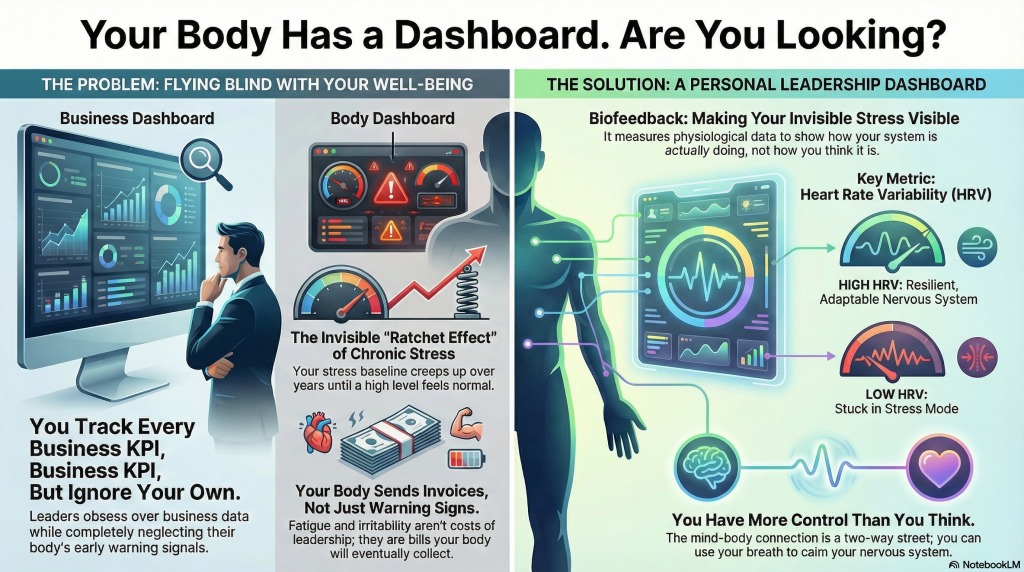
Here’s the thing. We love dashboards as leaders. We track revenue, margins, customer acquisition costs, and NPS scores. We’ve got real-time visibility into everything that matters in our businesses.
But what about the system that runs all of it? What about you?
Biofeedback is exactly what it sounds like: biological feedback. It’s the measurement of physiological indicators that tell you how your mind is actually doing, not how you think it’s doing.
And that distinction matters more than most executives realize.
The Metric That Changed How I Think About Stress
One number in particular grabbed my attention: Heart Rate Variability, or HRV.
HRV measures the variation in time between each heartbeat. Counterintuitively, more variability is better. It signals that your nervous system is flexible and responsive, that it can shift gears smoothly between stress and recovery. High HRV means resilience. Low HRV means your system is stuck in chronic activation mode.
When you’re stressed and depleted, your HRV drops. Your heart becomes more metronomic, less adaptable. It’s your body’s way of telling you the recovery tank is running low, even when your mind insists you’re fine.
The problem? Most executives never see this number. They just feel tired and push through anyway.
The Ratchet Effect Made Visible
I’ve written before about how stress doesn’t resolve cleanly in modern leadership. There’s no tiger to outrun. Instead, you have unresolved conversations, impossible timelines, and disappointments you pretend didn’t sting. Your body lowers the alarm a little after each stressor, but not all the way. Your baseline creeps up. Then another hit. Higher still.
Twenty years go by, and you’re living at a stress level of six when you used to live at two. You think you’re managing well because nothing has exploded. But your nervous system is bracing constantly, and you don’t even know it.
Bio-feedback makes that invisible ratchet visible.
When I started tracking my own data, I could finally see what I’d been feeling but couldn’t name. The numbers didn’t lie. My body was keeping score long before my mind was willing to admit anything was wrong.
Building Your Personal Leadership Dashboard
After my crash, I became obsessed with the idea of a personalized dashboard for the KPIs that actually matter: the ones that keep me self-aware about where I’m heading before I get there.
I landed on a wearable device that tracks HRV, sleep quality, recovery scores, and strain. For me, it was Whoop. Others use Oura or Garmin or Apple Watch. The specific tool matters less than the commitment to pay attention.
Now I get daily reports. Weekly trends. Monthly patterns. It’s the same discipline I used to apply to financial forecasts, except the asset I’m managing is myself.
And here’s what I’ve learned: the data creates accountability that willpower alone never could. When my recovery score tanks three days in a row, I can’t pretend I’m fine. The dashboard won’t let me.
The Mind-Body Connection Is a Two-Way Street
The monks at the Himalayan Institute understood something that Western medicine took decades to validate: the mind-body connection is real, and it’s bidirectional.
Get stressed, and your breath becomes shallow and rapid. But here’s the part that changed everything for me: breathe wrong, and you elevate your stress baseline. The arrow points both ways.
This means you have more control than you think. Not through willpower or discipline in the way most leaders understand those words. But through the body itself.
Slow your breath, and your nervous system follows. Lower your heart rate intentionally, and your mind calms. Complete a stress cycle through movement or breath work, and your baseline can actually drop.
Biofeedback tools make this process visible in real time. You can watch your HRV respond to a breathing exercise. You can see your recovery score climb after a genuine rest day. The feedback loop becomes tangible, not theoretical.
Why This Matters for Burnout Prevention
I’ve talked about the Denial Tax: the cost of convincing yourself you can outrun biology. Every act of avoidance adds another line to the balance sheet your body is quietly maintaining.
Biofeedback is how you audit that ledger before the bill comes due.
It won’t prevent every crash. But it gives you something most executives don’t have: early warning signals that you can actually see.
Because your body isn’t going to wait for you to finish the quarter before it collects. It doesn’t care about your timeline. It’s tracking its own metrics, running its own reports. The question is whether you’re going to look at them or keep flying blind.
I crashed because I ignored signals my body sent me. The fatigue. The shallow sleep. The shortened temper. I told myself those were just the costs of leadership.
They weren’t costs. They were invoices.
The Real Question
What would change if you could see your stress levels the way you see your P&L?
What decisions might you make differently if you knew, with data, that your capacity was declining week over week?
I can’t answer that for you. But I can tell you that once I started paying attention to the dashboard my body was already running, everything about how I lead began to shift.
Your body is keeping score. The only question is whether you’re willing to look.
Ready to stop the judgment loop and lead from clarity instead of reactivity? Schedule a discovery call and let’s talk about the mental fitness foundation that could change how you show up as a leader.
Subscribe to Project Crash for more insights on preventing executive burnout before it starts: https://www.linkedin.com/newsletters/project-crash-7395172366567514112