
Let It Out: What Crying Taught Me About Leadership (and Being Human)
Spring 2014. I was standing in my office in Lancaster, Pennsylvania, staring at my screen. I was the brand manager for a leading organic pest control company, and we’d just launched a new e-commerce program targeting small organic farmers. An order notification had just come through. Several thousand dollars. Our first real sale.
And I started crying.
Not sad crying. Not frustration crying. Happy crying. Overwhelmed-by-the-moment crying. The kind where your body decides to do something before your brain can stop it.
I was mortified. I shut my door, wiped my face, and prayed nobody had seen. A grown man, a senior leader, crying at his desk because a sales notification popped up on his computer.
What was wrong with me?
Turns out, nothing. Everything, actually, was working exactly as designed.
The Biology Behind Your Tears
Here’s the thing about crying that nobody tells you: it’s one of the most distinctly human things we do.
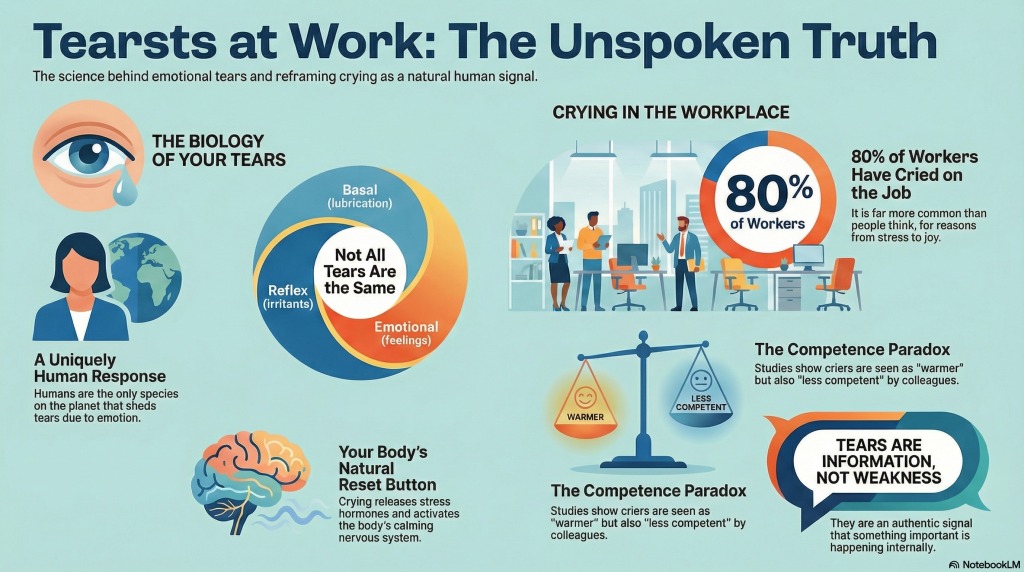
Scientists have studied tears for decades, and they’ve identified three types. Basal tears keep your eyes lubricated and healthy—just basic maintenance. Reflex tears flush out irritants like smoke or onion fumes. But emotional tears? Those are something else entirely.
Emotional tears appear to be uniquely human. No other species on the planet sheds tears in response to feelings. Dogs whimper. Elephants vocalize. Primates make distress calls. But only humans produce actual tears when overwhelmed by sadness, joy, frustration, or gratitude.
Researchers believe emotional crying evolved from infant distress calls—the way babies signal they need help before they have words. Somewhere in our evolutionary history, that vocal signal merged with tear production. And it stuck because it worked.
Why We Cry at Work: It's More Common Than You Think
One survey found that more than 80 percent of workers admit to crying at work. Eighty percent. That means almost everyone you’ve ever worked with has shed tears in a professional setting, whether you knew it or not.
The reasons vary. Stress from impossible deadlines. Conflict with a boss or colleague. Bad news from home crashing into the workday. And yes—sometimes overwhelming positive emotions, like watching a project finally succeed.
But here’s where it gets complicated.
Research shows that people who cry at work often get labeled as weak, unprofessional, or even manipulative. One study found that criers are seen as “warmer” but “less competent”—a devastating combination in environments that reward performance above all else.
So we hide it. We close our doors. We excuse ourselves to the bathroom. We pretend it didn’t happen and hope nobody noticed.
I know I did.
The Different Faces of Tears
Not everyone cries for the same reasons, and that’s important to understand.
Some people cry when they’re sad—the classic response to loss or disappointment. Others cry when they’re angry, their frustration so intense it has to go somewhere. And then there are people like me, who cry most often when overwhelmed by positive emotions.
Researchers call this “dimorphous expression”—when your body responds to an intense positive feeling with what looks like a negative reaction. Think of Olympic athletes sobbing on the podium after winning gold. Their joy is so enormous, so uncontrollable, that it triggers the same response we associate with grief.
The hypothesis is that this serves a regulatory function. When emotions become too intense to manage—even good ones—crying helps your nervous system restore balance. It’s like a pressure valve releasing steam.
That day in Lancaster, watching that first order come through? I’d worked for months building that program. The uncertainty, the doubt, the late nights wondering if it would work. And then it did. My body didn’t know what else to do with all that relief and pride and hope.
So it cried.
The Cathartic Effect: Does Crying Actually Help?
The science here is surprisingly mixed.
For a long time, people believed crying was cathartic—that a good cry releases toxins, clears stress hormones, and leaves you feeling better. And there’s some evidence to support this. Research shows that emotional tears contain higher levels of stress hormones like cortisol, suggesting your body may literally be purging stress through your tears.
Crying also activates your parasympathetic nervous system—the “rest and digest” system that helps calm you down after a stress response. Studies have found that heart rate decelerates just before crying begins, then returns to baseline during the first crying episode. Your body is essentially hitting its own reset button.
After extended crying, your body releases oxytocin and endorphins—natural mood boosters and pain relievers. That sense of calm or even slight numbness you feel after a good cry? That’s chemistry, not imagination.
But here’s the nuance: whether crying helps depends heavily on context. If you cry alone with no resolution to what caused the tears, you might actually feel worse afterward. If you cry in a supportive environment where someone responds with comfort, the benefits compound.
Crying isn’t magic. It’s a signal—to yourself and to others—that something important is happening. What happens next determines whether you feel better or worse.
Should Crying Be Shamed or Embraced?
I’ve thought about this question a lot since that day in Lancaster. And since my breakdown at the Fort Lauderdale airport, when the tears came whether I wanted them to or not.
The honest answer? Both approaches miss the point.
Crying isn’t something to be ashamed of. It’s a biological response that evolved for good reasons—to signal distress, to invite support, to regulate emotions that have grown too intense to contain. Research shows that people who cry more readily often score higher on emotional intelligence. They’re better at understanding and managing their emotions, and the emotions of others.
But crying also isn’t something to force or perform. The power of tears lies in their authenticity. They signal to others that something real is happening, something beyond our ability to mask or control. That’s why we respond to them with empathy. And that’s why fake tears feel manipulative—they exploit that hardwired response.
What I’ve learned is that tears are information. They tell you something important is happening inside you. They invite you to pay attention rather than power through.
Real Talk About Tears and Leadership
Modern workplaces still struggle with emotional expression. We’ve built cultures that reward composure and punish vulnerability. And that creates a strange disconnect—we want authentic leaders, but we penalize the most authentic human response to intense emotion.
The research is clear: crying at work can damage your reputation. But it’s equally clear that suppressing emotions chronically leads to burnout, disengagement, and worse outcomes for everyone.
So what’s the answer?
I think it starts with giving ourselves permission to be human. Not performing emotion for effect. Not suppressing it until we shatter. Just acknowledging that sometimes the things we care about most will move us in ways we can’t control.
That first sale in Lancaster wasn’t just a transaction. It was months of work, countless decisions, risks taken and doubts overcome. My tears weren’t weakness. They were evidence that I cared deeply about something I’d built.
The breakdown at Fort Lauderdale was different—those tears were my body finally forcing me to acknowledge what my mind refused to admit. That I was running on empty. That the facade of “everything is fine” had crumbled.
Both were honest. Both were necessary. Both taught me something important.
The Invitation
So here’s my question for you: When was the last time you let yourself cry?
Not because something terrible happened. But because something mattered enough to overwhelm your carefully maintained composure?
If you can’t remember, that might be worth paying attention to. Not because crying is good or bad, but because the absence of emotion often signals something deeper—a disconnection from what matters, a numbness that accumulates over time.
The body keeps score. Tears are just one way it tells us.
Crying might be the most human thing we do. It’s also one of the most stigmatized in professional settings. If you’re navigating the tension between being authentic and being perceived as competent, you’re not alone.
Subscribe to Project CRASH for more conversations about the hidden costs of leadership—and the path back to sustainable performance.
Subscribe to the Project CRASH Newsletter
Ready to explore what’s really driving your stress? Book a discovery call and let’s talk about the blind spots that might be building pressure you haven’t named yet.