
Decision Fatigue: The Silent Drain on Executive Performance
You’ve probably heard about Steve Jobs wearing the same black turtleneck every day, or Mark Zuckerberg’s gray t-shirt uniform. The standard explanation is that eliminating trivial decisions preserves mental energy for important ones.
But here’s the thing: the real story of decision fatigue is far more alarming than wardrobe choices. And it has direct implications for how you lead, when you lead, and whether your judgment can be trusted at 4pm the same way it can at 9am.
The Science Behind Cognitive Depletion
Decision fatigue isn’t a metaphor. It’s a measurable decline in the quality of decisions after a long session of decision-making. The brain’s prefrontal cortex, the region responsible for complex thought, planning, and self-regulation, becomes less effective as mental resources are consumed. Every choice draws from a limited pool of cognitive energy. As that reservoir drains throughout the day, executives become prone to poor judgment, impulsivity, avoidance, or defaulting to the safest option even when it’s suboptimal.
McKinsey research shows that executives spend nearly 40% of their time making decisions, and most admit that time is poorly used. A Harvard Business Review estimate suggests CEOs make around 50 high-stakes decisions per day. Add the hundreds of micro-decisions, from email responses to meeting scheduling, and the cognitive load becomes staggering.
When Judges Get Hungry: The Research That Should Worry You
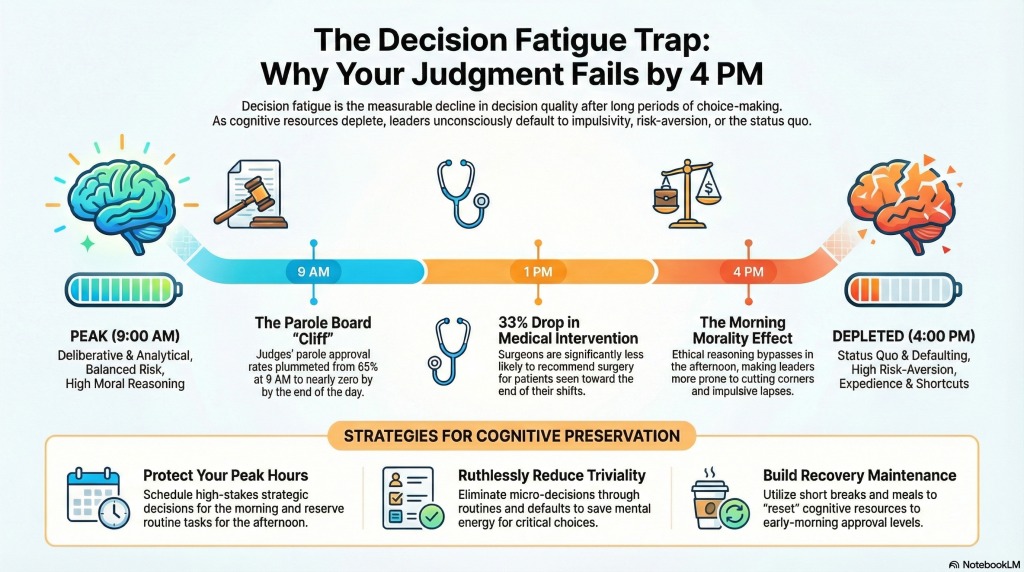
The most striking demonstration of decision fatigue comes from a 2011 study of Israeli parole boards. Researchers analyzed over 1,100 judicial rulings and found something alarming: judges granted parole to about 65% of prisoners they saw at the beginning of the day or right after a food break. But that approval rate dropped to nearly zero by the end of each session.
Read that again. Nearly zero.
The judges weren’t being deliberately harsh. They were cognitively depleted. When mental resources ran low, they defaulted to the status quo: keep the prisoner incarcerated. It was the easier, safer choice. The one that required less cognitive effort to justify.
Now think about your own afternoon meetings. The strategic decisions you’re making at 4pm after a day of back-to-back calls. The performance review you’re conducting after lunch. Are you bringing the same quality of judgment you had at 9am?
How Decision Fatigue Shows Up in the C-Suite
The research extends well beyond courtrooms. A study of orthopedic surgeons found that patients seen toward the end of a doctor’s shift were 33 percentage points less likely to be scheduled for surgery compared to those seen first. The surgeons weren’t being negligent. They were defaulting to the conservative option, choosing not to operate, because it required less cognitive effort than carefully weighing the pros and cons of intervention.
For executives, decision fatigue manifests in predictable ways. You start avoiding decisions entirely, pushing them to tomorrow. You default to whatever option maintains the status quo. You become more impulsive on small things because you’ve exhausted your capacity for deliberation. Or you become risk-averse on big things, choosing the safe path because evaluating alternatives feels overwhelming.
And here’s what should really concern you: research has established what psychologists call the “morning morality effect.” People are more likely to engage in unethical behavior, such as cutting corners or making questionable judgment calls, in the afternoon than in the morning. When cognitive resources are depleted, ethical reasoning gets bypassed in favor of expedience. Baumeister and Vohs, the researchers who pioneered decision fatigue studies, have suggested that the “disastrous failure of men in high office to control impulses in their private lives” may at times be attributed to decision fatigue stemming from the burden of day-to-day decision making.
The Connection to Executive Burnout
Decision fatigue and burnout are deeply connected. The chronic mental strain of continuous high-stakes decision-making exacerbates feelings of stress, anxiety, and irritability. Over time, this cumulative cognitive burden elevates the risk of burnout: emotional exhaustion, cynicism, and a reduced sense of personal accomplishment.
When I burned out as a CEO, decision fatigue was part of the picture I didn’t fully understand at the time. The constant stream of choices, from strategic pivots to personnel issues to operational details, was depleting my capacity for good judgment long before I recognized what was happening. By the time the important decisions landed on my desk, I was often operating on fumes.
Protecting Your Decision-Making Capacity
The good news is that decision fatigue isn’t inevitable. It’s manageable once you understand how it works.
First, protect your peak hours. Schedule your most important decisions for when your cognitive resources are highest, typically earlier in the day. Reserve afternoons for routine work, delegated choices, or tasks that don’t require complex judgment. This isn’t about being a morning person. It’s about respecting the brain’s operational limits.
Second, ruthlessly reduce trivial decisions. The wardrobe simplification strategy works because it eliminates cognitive load, not because black turtlenecks are inherently powerful. Look for other areas where you can create defaults, routines, or systems that remove the need for daily deliberation.
Third, build in recovery. The Israeli judges’ approval rates reset to 65% after breaks. Short pauses, meals, even brief walks can restore cognitive resources. The research on breaks shows they’re not luxuries. They’re maintenance for your decision-making machinery.
Fourth, delegate strategically. Not everything needs to roll up to you. When every decision crosses the executive desk, leaders drown in operational detail and exhaust their capacity for the strategic calls that actually require their judgment. Distributed decision-making isn’t just empowering for teams. It’s cognitive preservation for leaders.
Recognizing Your Own Warning Signs
Decision fatigue doesn’t announce itself. It accumulates quietly. Watch for these signals: hesitation on calls you’d normally make confidently, second-guessing decisions you’ve already made, defaulting to “let’s discuss this later,” irritability that seems disproportionate to the situation, or finding yourself drawn to whatever option requires the least effort to explain.
When you notice these patterns, the answer isn’t to push through. It’s to step back, recover, and protect your remaining cognitive resources for what actually matters.
Because here’s the uncomfortable truth: you’re not the same leader at 5pm that you were at 9am. Understanding that isn’t weakness. It’s wisdom. And designing your days around that reality isn’t accommodation. It’s strategy.