
Your Meetings Are Lying to You
Let me ask you something.
When was the last time you walked out of a meeting feeling like something actually got done?
Not scheduled. Not discussed. Not tabled for the next meeting about the meeting.
Actually done.
If you had to think about it for more than three seconds, you already know the answer.
Here’s the thing — meeting culture is one of the most quietly destructive forces inside organizations today. And most leaders never see it coming. Because on the surface, meetings look like productivity. Calendars are full. People are talking. Decisions are being made, sort of. The wheels appear to be turning.
But appearances can be deceiving.
What Peter Drucker Knew That We Keep Forgetting
Peter Drucker said it decades ago, and it still stings: “Meetings are a symptom of bad organization. The fewer meetings the better.”
He wasn’t anti-collaboration. He was anti-waste. And he understood something that most organizations still haven’t internalized — that time is the one resource you cannot manufacture more of. Every hour lost to a poorly structured meeting is an hour your team can never get back.
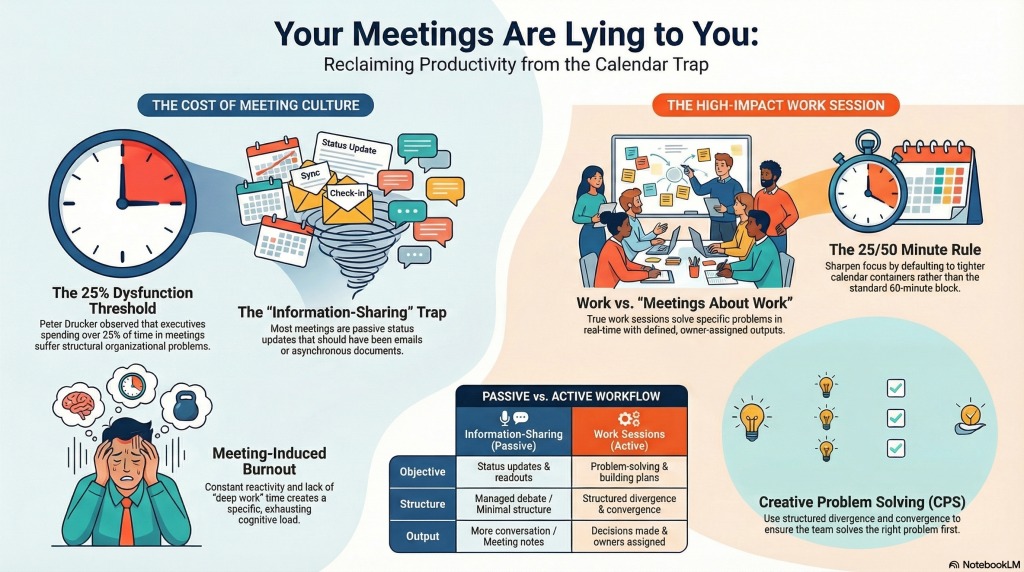
Drucker also observed that executives who spend more than twenty-five percent of their time in meetings are suffering from a structural problem. Not a discipline problem. Not a motivation problem. A structural one.
Think about that. How does your calendar compare?
Most of the leaders I work with are well past that threshold. Some are spending sixty, seventy percent of their week in meetings. And here’s the part that should concern you: they’re exhausted, and they can’t always explain why. The meetings feel necessary in the moment. But the cumulative drain is real.
That’s not a coincidence. It’s a symptom.
The Real Problem With Meeting Culture
Here’s what I’ve observed working inside dozens of organizations: the biggest culprit isn’t too many meetings. It’s the wrong kind of meetings dominating the calendar.
Most organizations skew heavily toward information-sharing meetings. Status updates. Readouts. Presentations. Progress reports.
Nothing wrong with sharing information. Except that most of the time, that information could have been an email, a shared document, or a quick asynchronous video. Instead, it gets dressed up as a meeting, consumes forty-five minutes of seven people’s time, and produces nothing that didn’t already exist.
What gets crowded out? Work sessions.
A real work session is different. It’s not a meeting about work. It’s work — happening in real time, with the right people in the room, solving a specific problem or building a concrete plan. It has a clear objective, a defined output, and it ends with decisions made and owners assigned.
The ratio shift between these two types of meetings is one of the most transformational things I help organizations do. When I flip the balance — reducing passive information-sharing and increasing structured working sessions — the change in energy, output, and morale is almost immediate.
I’ve seen it again and again. Fewer calendar blocks. More actual progress.
Duration, Cadence, and the Silent Killers
Let’s talk mechanics, because the details matter.
Duration: We default to sixty-minute meetings because that’s what the calendar app suggests. But most meaningful conversations and decisions happen in the first twenty minutes — and then we fill the remaining forty. Try defaulting to twenty-five or fifty minutes instead of thirty and sixty. The pressure of a tighter container often sharpens focus dramatically.
Cadence: Standing meetings that outlive their usefulness are organizational deadweight. A weekly team sync that made sense when a project was in crisis doesn’t automatically become obsolete when the crisis passes. It just keeps recurring. Audit your recurring meetings once a quarter. Ask which ones you’d start today if they didn’t already exist. That list gets shorter fast.
Format: Standing agenda, rotating facilitator, and no phones aren’t just best practices — they’re signals to your team that the time together is being taken seriously. Leaders set the tone. If you’re multitasking in meetings, so is everyone else.
The Case for Creative Problem Solving
When it comes to running effective work sessions, I’m a committed advocate for a specific process: Creative Problem Solving, or CPS.
CPS was developed in the 1950s by Alex Osborn and Sidney Parnes, and it has been refined over decades into a disciplined yet genuinely creative framework for tackling complex organizational challenges. It’s not brainstorming. It’s structured divergence followed by structured convergence — a process that ensures you’re solving the right problem before you start generating solutions.
What I love about CPS in work sessions is that it respects the intelligence in the room without letting the loudest voice dominate. It creates safety for unconventional thinking. And it produces outputs — decisions, plans, owner assignments — not just conversation.
Contrast that with the typical executive work session: ninety minutes of debate, minimal structure, the most senior person’s opinion wins by default, and someone agrees to write up the notes that nobody reads.
CPS isn’t magic. But it gives teams a process they can trust, especially when the stakes are high and the problem is genuinely hard.
If your work sessions feel like managed debates rather than actual problem-solving, CPS is worth a serious look.
What This Has to Do With Burnout
You might be wondering why I’m writing about meetings. This is a burnout newsletter, after all.
Here’s the connection: meeting culture is one of the most underrated contributors to executive exhaustion. Not because meetings are inherently bad. But because back-to-back passive meetings, with no time to think or produce, create a specific kind of depletion. You’re always reacting. Never creating. The cognitive load is enormous, and the sense of agency shrinks.
I’ve watched capable, driven executives grind themselves down inside calendars that left no room for deep work, strategic thinking, or recovery. They weren’t lazy. They were trapped in a structure that rewarded presence over output.
Changing the meeting culture is one of the levers. Not the only one. But a meaningful one.
Start Here
You don’t need to overhaul your entire calendar tomorrow. But here’s a simple diagnostic:
Look at your meetings from the last two weeks. Sort them into two buckets: information-sharing and working sessions. What’s the ratio?
If most of your meetings fall in the first bucket, you have your starting point.
Cancel one recurring meeting this month that nobody would genuinely miss. Replace it with a structured working session on your team’s most stuck problem. Bring a clear objective, a defined output, and a process — CPS or otherwise.
See what happens.
If you’re ready to go deeper on the patterns that are quietly costing you more than meeting time, visit www.TenBlindSpots.com to take the burnout risk assessment. It takes about ten minutes and gives you a scored view of where you stand across the ten blind spots that lead to burnout.