
Psychological Safety: The Hidden Foundation Every Leader Overlooks
I crashed in November 2023.
At the Fort Lauderdale Airport, waiting for a flight home after running a private equity-backed company through five acquisitions, I fell apart. Broke down. Couldn’t stop crying. Crumbled in a way that would have been unthinkable to me just months before.
In the aftermath, I did what most analytical leaders do. I started asking why. I dug into research. I peeled back layer after layer of the leadership onion, trying to understand what had really gone wrong beneath all the visible metrics, all the closed deals, all the appearances of success.
And here’s the thing: no matter which topic I explored, whether it was team dysfunction, hidden stress, perfectionism, or transactional thinking, I kept landing on the same concept at the root of the solution. A term I’d never heard before I started this journey.
Psychological safety.
What Psychological Safety Actually Means
The phrase comes from Harvard Business School professor Amy Edmondson, who first coined it in the late 1990s. Her research began with a puzzling finding: the highest-performing hospital teams reported more mistakes than the lower-performing ones.
Not because they made more errors. Because they felt safe admitting them.
Edmondson defines psychological safety as a shared belief that a team is safe for interpersonal risk-taking. It means you can ask a question without looking stupid. Admit a mistake without being punished. Challenge an idea without getting shut down. Show up imperfectly without losing your standing.
This isn’t about being comfortable or avoiding difficult conversations. Quite the opposite. Psychological safety is about making it safe to have the uncomfortable conversations. It’s the foundation that allows real honesty and real progress.
Why This Matters More Than You Think
Here’s what nobody tells you about high-performing teams: the secret ingredient isn’t talent. It isn’t credentials. It isn’t the individual brilliance of the people in the room.
Google discovered this the hard way. In 2012, they launched Project Aristotle, a massive internal research initiative studying over 180 teams to understand what made some consistently outperform others. They looked at everything: demographics, personality traits, educational backgrounds, tenure.
None of it mattered nearly as much as one dynamic.
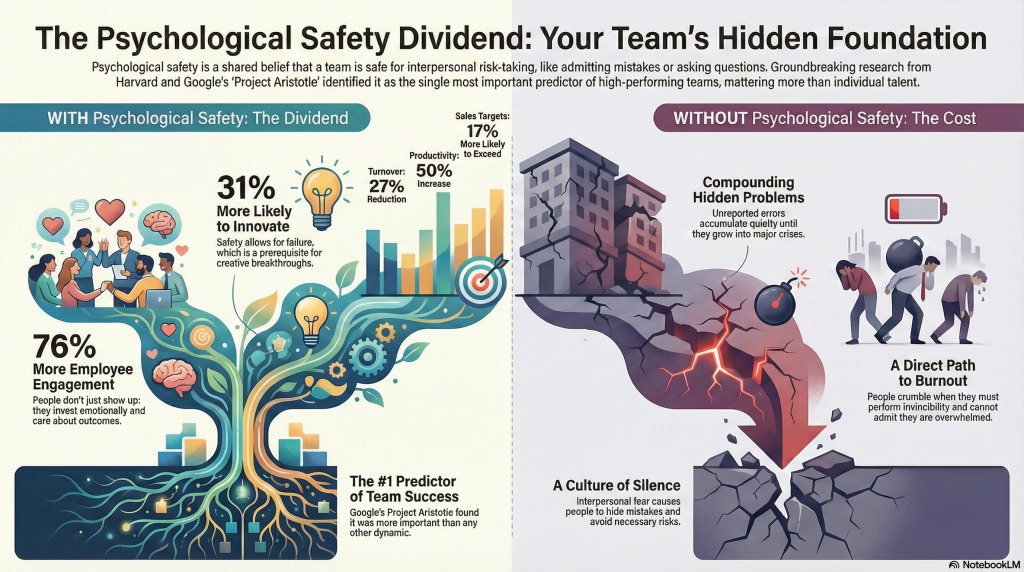
Psychological safety was, by far, the strongest predictor of team performance. Teams with high psychological safety exceeded sales targets by 17%. They reported higher innovation, lower turnover, and stronger engagement. The “who” on the team mattered far less than the “how” the team worked together.
And the research keeps confirming it. Studies have shown that organizations prioritizing psychological safety see a 27% reduction in turnover, 76% more engagement, and 50% more productivity. When people feel safe to speak, everything gets better.
The Five Key Benefits of Psychological Safety
When leaders intentionally create and nurture psychological safety, the ripple effects are profound.
Innovation and Creative Risk-Taking
In a psychologically safe environment, people don’t hide their half-baked ideas. They bring them forward. They experiment. They iterate. Research shows teams with high psychological safety are 31% more likely to propose and implement new ideas.
Why? Because innovation requires failure. And failure requires safety. When employees know they won’t be punished for trying something that doesn’t work, they stop playing it safe. They push boundaries. They explore the edges where breakthroughs live.
Diverse teams, in particular, see dramatic benefits. When people feel safe to share perspectives that might be different from the majority, organizations actually capture the value of the diversity they’ve hired. Without psychological safety, diverse teams often underperform homogeneous ones because the different viewpoints stay silent.
Error Detection and Organizational Learning
Remember those high-performing hospital teams that reported more mistakes? The key word is reported.
In environments where mistakes are punished or hidden, error reporting collapses. Problems accumulate quietly. Risks compound until they explode. But when organizations shift to a learning culture, error reporting increases dramatically while actual errors decrease.
This applies far beyond healthcare. In any organization, the most dangerous problems are the ones no one talks about. Psychological safety brings those problems into the light before they become catastrophes.
Employee Retention and Engagement
Only about 3% of employees are at risk of leaving organizations with strong psychological safety. Compare that to environments lacking this element, where turnover can be three to four times higher.
People stay where they feel valued and respected. Where their voices matter. Where they can bring their whole selves without fear. In today’s competitive talent market, that’s not just nice to have. It’s essential.
Beyond retention, psychological safety directly impacts engagement. When people feel safe, they don’t just show up. They show up fully. They offer ideas. They invest emotionally. They care about outcomes in a way that transcends the job description.
Faster Learning and Adaptation
Organizations that feel safe learn faster. Teams share knowledge more freely. Individuals ask for help without shame. Feedback flows in all directions, not just top-down.
Research shows that workers learn at a faster rate when they feel psychologically safe and are 67% more likely to apply newly learned skills on the job. In a world that demands constant adaptation, this accelerated learning cycle is a significant competitive advantage.
Improved Mental Health and Wellbeing
This one hits close to home.
Burnout doesn’t happen in a vacuum. It happens when people feel they can’t show struggle. When they can’t admit they’re overwhelmed. When they have to perform invincibility while crumbling inside.
Psychological safety won’t prevent every mental health challenge. But it creates conditions where people can ask for help before they crash. Where they can set boundaries without career suicide. Where the slow-building pressure can find a release valve before the whole system blows.
What Happens When Psychological Safety Is Absent
The absence of psychological safety doesn’t just remove these benefits. It creates an actively toxic dynamic.
When people don’t feel safe, they stay silent. They hide mistakes. They avoid risks. They manage impressions instead of solving problems. Research shows that interpersonal fear, the perception that speaking up will lead to humiliation or punishment, is one of the strongest predictors of silence in organizations.
The consequences are measurable. Higher stress and burnout. Stifled creativity. Compromised ethical standards. Lower quality work. Increased turnover, especially among the people you can least afford to lose.
And here’s the cruel irony: the leaders who need to hear honest feedback the most are often the ones who receive it the least. Perfectionist leaders, in particular, create environments where fear suppresses exactly the information they need. When the leader cannot tolerate mistakes, neither can anyone else. Those impossible standards spread through the organization without ever being spoken.
I’ve written about this extensively in my book. Transactional relationships kill psychological safety at its foundation. Perfectionism creates teams that report significantly lower safety. Performance-based identity makes feedback feel like an existential threat.
These aren’t separate problems. They’re interconnected patterns that erode the foundation every team needs to thrive.
The Leadership Imperative
Here’s the real talk: creating psychological safety is not about making people comfortable. It’s not about avoiding accountability. Amy Edmondson’s research shows that the highest-performing teams combine high psychological safety with high standards. Without safety, teams may appear agreeable but remain silent. Without standards, teams feel comfortable but lack rigor.
The sweet spot is a culture where it’s safe to speak up and where everyone is committed to excellence.
That requires intentional leadership. It means modeling vulnerability by admitting your own mistakes. It means inviting participation through genuine questions, not rhetorical ones. It means responding productively to feedback, not defensively. It means treating errors as data for improvement rather than evidence of failure.
A survey highlighted by McKinsey found that only 26% of leaders create psychological safety for their teams. Which means 74% of leaders are leaving massive performance gains on the table because they haven’t learned, or perhaps haven’t prioritized, this foundational skill.
The Connection to Burnout Prevention
I started this journey because I crashed. I write about burnout because I lived it.
And what I’ve come to understand is that psychological safety isn’t just about team performance. It’s about sustainability. It’s about whether your organization grinds people down or builds them up. It’s about whether the best ideas surface or stay hidden. It’s about whether problems get addressed or accumulate until they become crises.
When I look back at my own crash, I see the absence of psychological safety woven throughout the story. Not in my team necessarily, but in the broader system. The pressure to appear invincible. The inability to show struggle. The culture that celebrated results while ignoring the human cost of achieving them.
Creating psychological safety won’t solve everything. But it creates the conditions where problems can be named, patterns can be interrupted, and people can get the support they need before they break.
That’s why it kept appearing at the root of every solution I explored. It’s foundational. It’s the hidden ingredient. It’s what transforms a group of talented individuals into a team that actually works.
And that’s why I believe every leader needs to understand it, nurture it, and defend it.
Psychological safety is one of the key themes I explore in my book “Crash and [Burn] LEARN: A Business Fable About the High Cost of Burnout, Blind Spots, and the Hope of Recovery.” The book examines ten blind spots that lead to burnout, many of which directly undermine the psychological safety teams need to thrive.
If this resonates with you, I invite you to join the Project CRASH community where we explore these topics every week. Subscribe to the Project CRASH Newsletter and let’s continue the conversation together.