
The Competence Illusion: Why Knowing Has Almost Nothing to Do with Doing
You can explain exactly why you’re overwhelmed while still being overwhelmed. You understand precisely why your stress patterns keep repeating while continuing to repeat them. You can name every bad habit you have while being run by all of them.
Welcome to the Competence Illusion. It’s Blind Spot #10 in my framework, and it might be the most dangerous one of all.
The Knowing-Doing Gap in Executive Leadership
High performers fall into this trap more often than anyone else. It doesn’t show up in performance reviews, and it doesn’t look like a flaw. In fact, it feels like strength. You feel capable. You feel informed. You feel prepared. You can articulate your triggers, your patterns, your stress cycles. You can explain them to others with precision.
And that is exactly what makes the trap so dangerous.
The most costly blind spot in leadership isn’t ignorance. It’s the belief that knowledge is the same as mastery. That understanding a concept is the same as embodying it. That being able to articulate a practice means you’re actually practicing it.
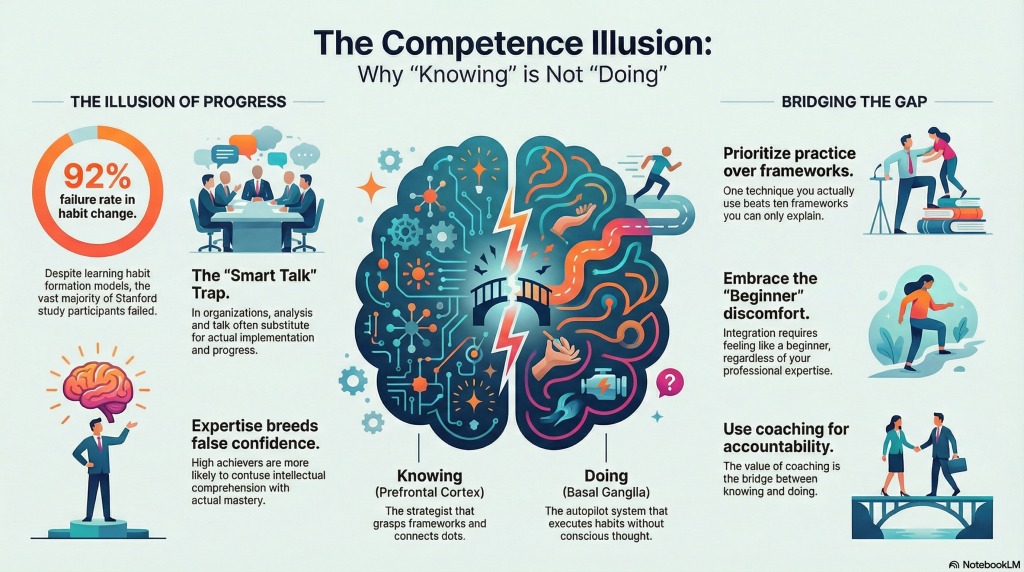
Stanford professors Jeffrey Pfeffer and Robert Sutton spent years researching what they called the knowing-doing gap. Their conclusion was striking: the gap between knowing and doing is more important than the gap between ignorance and knowing. Companies pour billions into training programs and consulting, acquiring endless knowledge about how to improve. Yet very little actually changes.
Why? Because organizations, like individuals, fall into what Pfeffer and Sutton call the “smart talk trap.” Talk substitutes for action. Analysis substitutes for implementation. The feeling of progress replaces actual progress.
Why Understanding Doesn't Create Change
Here’s the neuroscience that explains the trap. The part of your brain that understands a concept is not the part that executes habits.
Your prefrontal cortex is the brilliant strategist. It grasps frameworks, connects dots, appreciates nuance. But habit lives in the basal ganglia, the autopilot system that runs the majority of your day without conscious thought. These two systems don’t communicate efficiently. So we end up believing something that feels true but is completely false: “I understand it, therefore I am doing it.”
A Stanford study made this painfully clear. Participants were taught the full model of habit formation. They learned how cues trigger routines. They understood how reward cycles create neural pathways. They could explain the basal ganglia’s role in repetition. Six weeks later, ninety-two percent had failed to change a single habit.
They had the knowledge. They lacked the integration.
How High Achievers Make It Worse
The disconnect becomes even more extreme in high achievers. The more competent you are intellectually, the more likely you are to confuse comprehension with embodiment. You gather knowledge quickly. You absorb frameworks easily. You connect concepts effortlessly. And because you’re good at it, you assume the rest will unfold naturally.
Except it doesn’t.
Research shows that the more expertise someone has, the more susceptible they are to this cognitive illusion. Confidence rises faster than competence. Knowledge becomes armor rather than access. Leaders collect certifications and books and trainings, not because they intend to practice them, but because the knowledge itself feels like progress.
You’ve seen this. Leaders who can define emotional intelligence while blowing up at their teams. Leaders who describe the neuroscience of mindfulness while running on adrenaline and anxiety. Leaders who talk about boundaries while answering emails at midnight.
They know better. They don’t do better. It’s not hypocrisy. It’s neuroscience.
The Unique Suffering of Knowing Without Doing
Knowledge without practice creates a unique kind of suffering. The gap between knowing and doing slowly becomes torture. You see the problem clearly. You understand the solution. And still, nothing changes.
It’s like being a physical therapist with chronic back pain. A financial planner drowning in debt. A physician ignoring their own symptoms.
This isn’t incompetence. It’s disconnection. The problem isn’t failure. The problem is the belief that understanding protects you from failing.
Closing the Gap: From Knowledge to Practice
The path out of the Competence Illusion isn’t more knowledge. It’s different relationship with knowledge.
First, accept that understanding is only the beginning, not the destination. Every insight you’ve gathered is raw material, not finished product. It has to be practiced, tested, failed at, and tried again before it becomes part of how you actually operate.
Second, build small practices instead of accumulating big frameworks. One technique you actually use beats ten frameworks you can explain. Start with the smallest possible action that moves you from knowing to doing.
Third, get uncomfortable. Practice requires feeling like a beginner, even when your expertise tells you that you should already have this figured out. The resistance to that discomfort is exactly what keeps high achievers trapped in the illusion.
Fourth, find accountability. Not someone to teach you more, but someone to help you do what you already know. The value of coaching isn’t the knowledge transfer. It’s the bridge between knowing and doing.
Knowledge soothes the ego. Practice rewires the brain. And until you practice, nothing changes.
The Real Measure of Learning
I fell into the Competence Illusion myself during my years as CEO. I read the books on stress management. I understood the research on recovery. I could articulate exactly why sustainable pace matters for long-term performance. And none of that knowledge prevented my breakdown in Fort Lauderdale Airport.
Understanding didn’t protect me. It just made the collapse more confusing. How could someone who knew so much about burnout still burn out?
The answer is that knowing and doing operate in completely different parts of the brain. And until we bridge that gap with actual practice, we remain vulnerable to patterns we can perfectly describe but cannot seem to escape.
The real measure of learning isn’t what you can explain. It’s what you consistently do when no one is watching, when stress is high, when the old patterns would be so much easier. That’s where knowledge either becomes embodied or remains an illusion.