
The Confidence Pendulum
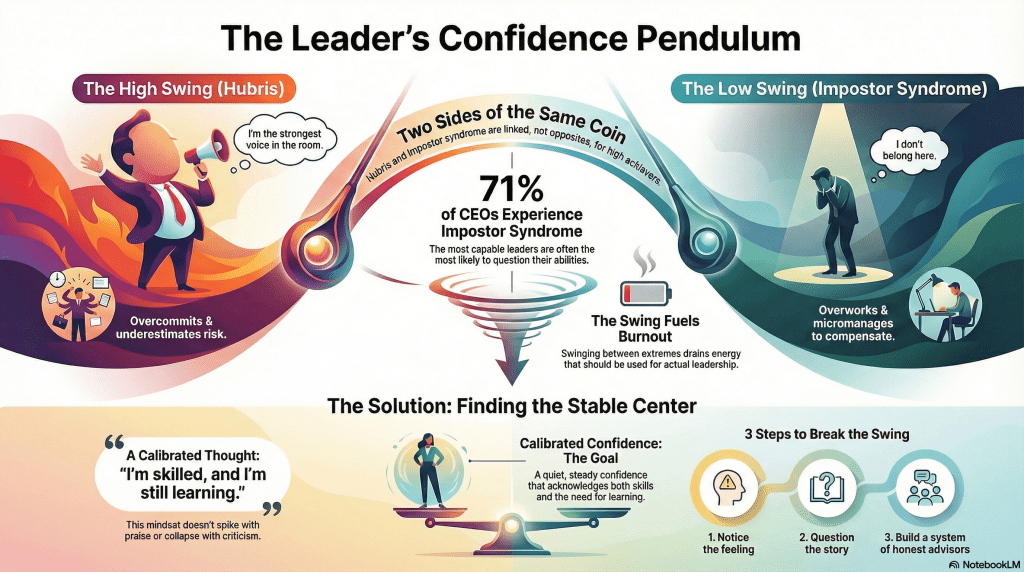
Why High Achievers Swing Between “I’ve Got This” and “I’m a Fraud
One moment I was certain I was the smartest person in the room.
The next, I was convinced everyone was about to figure out I had no idea what I was doing.
Same week. Same role. Same me.
If you’ve led at a high level for any length of time, you probably know exactly what I’m talking about. That dizzying swing between feeling unstoppable and feeling like an imposter waiting to be exposed.
I used to think these were two separate problems. Overconfidence on one end. Self-doubt on the other. Opposite forces requiring opposite solutions.
I was wrong.
The Hidden Connection Behind Executive Self-Doubt
Here’s what took me years to understand: hubris and impostor syndrome aren’t opposites. They’re roommates. They share the same psychological address, feed off the same emotional wiring, and take turns running the show.
The research backs this up in uncomfortable ways. Seventy-one percent of CEOs report experiencing impostor syndrome. Seventy-five percent of female executives have felt it at some point in their careers. And here’s the kicker – high performers are more susceptible to it than average professionals.
Read that again.
The more capable you are, the more likely you are to question your own capability.
But here’s the thing about the pendulum – it doesn’t just swing toward doubt. It swings hard the other way too.
When Success Becomes a Setup for the Crash
Success has a way of inflating our sense of judgment. Each win strengthens the internal narrative: “I did that.” Over time, “I did that” quietly becomes “I can always do that,” which eventually hardens into “I cannot be wrong.”
The CEO title changes how people treat you. They defer to your ideas. They hesitate to push back. They respond to your opinions like they’re revelations. And slowly, all that deference becomes data. You start believing your own press.
Then something goes sideways. A missed quarter. A deal that falls apart. A board meeting where your confidence doesn’t land the way it usually does.
And the pendulum swings.
Hard.
The Emotional Whiplash of C-Suite Leadership
What I learned the hard way is that both ends of this pendulum are exhausting.
On the upswing, you’re thinking: I’m the strongest voice in the room. Everything is clicking.
On the downswing: I don’t belong here. Everyone can see I’m failing.
Both feel absolutely true in the moment. Neither one is.
The swing happens before you even realize it. Your mood shifts with results. Your confidence rises and falls based on feedback, approval, outcomes – all things outside your control. You’re not leading from a stable center anymore. You’re being dragged to each extreme by whatever just happened.
This is what makes the pendulum a blind spot. You can’t see the swing while you’re inside it. Overconfidence feels like confidence. Self-doubt feels like realism. Both are distortions.
Finding the Stable Center
The goal isn’t to eliminate the pendulum. That’s not how humans work. The goal is to reduce its amplitude – to catch the swing earlier and return to center faster.
In that center lives calibrated confidence. It sounds like this:
I played a role in this outcome, and other factors mattered too.
I don’t have all the answers, and I’m capable of figuring them out.
I made mistakes, and I can learn from them.
I’m skilled, and I’m still learning.
This kind of confidence is quieter. Less dramatic. It doesn’t spike with praise or collapse with criticism. And it doesn’t require constant validation to stay steady.
The Burnout Connection Nobody Talks About
Real talk about why this matters beyond emotional comfort: the pendulum fuels burnout.
When you’re swinging high, you overcommit. You underestimate risk. You say yes more often than you should. You believe you can handle more than any human reasonably can.
When you’re swinging low, you overwork. You micromanage. You refuse to rest because any sign of ease might expose you. You double down on effort to compensate for the fear of inadequacy.
Both directions drain you. The constant internal recalibration – the mental rewriting of “who am I today” – steals energy that should go toward actual leadership.
And the cruelest part? Leaders start confusing these emotional swings with insight. The highs feel like clarity. The lows feel like hard truths. Neither is accurate. Both are your nervous system reacting to stimuli, not your wisdom emerging from reflection.
Breaking the Swing
The first step is simply noticing. Catching yourself in the moment when confidence turns into certainty, or when worry turns into worthlessness.
The second is questioning the story. When you’re at either extreme, ask: What am I missing? What evidence contradicts this feeling? What would a trusted advisor say right now?
The third is building systems around yourself – people who will tell you the truth when you’re inflated and remind you of reality when you’re deflated. Not cheerleaders. Not critics. Calibrators.
I’ve lived on both ends of this pendulum. I’ve made decisions from the top of the swing that I deeply regretted. I’ve spiraled from the bottom into paralysis that cost me time, relationships, and health.
What I know now is that neither version was the real me.
The real me lives somewhere in between – capable and fallible, confident and learning, strong and still growing.
That’s where you can lead without the whiplash.
That’s where sustainable leadership actually lives.
Ready to explore what blind spots might be running the show in your leadership? The Confidence Pendulum is just one of ten patterns that quietly drive executives toward burnout. Let’s make sure your story doesn’t end the way mine almost did.
Book a discovery call at calendly.com/jgodbarge-gemconsultingsolutions/ten-blind-spots-discovery-call