
The Cost of Being "Fine": How Leaders Suppress Emotions (and Why It Backfires)
There was a period in my CEO life when someone would ask how I was doing and I had one answer.
“Fine.”
Didn’t matter what was actually happening. Missed a major acquisition target. Fine. Board meeting went sideways. Fine. Woke up at 3 a.m. for the fourth night in a row wondering if I was the right person for the job. Fine.
It was automatic. A reflex. And at the time, I believed it was a form of strength.
I was wrong.
The Emotional Armor That Leaders Wear
Here’s the thing about leadership: the higher you climb, the more pressure there is to perform emotional stability. Boards want calm. Teams want certainty. Investors want confidence. And somewhere along the way, many leaders learn to deliver all of that while quietly shoving everything else down.
We call it composure. We call it resilience. We tell ourselves it’s professional.
But there’s a difference between managing emotions and suppressing them. And most of us in the C-suite were doing the latter without even realizing it.
I was leading a PE-backed platform company through an aggressive roll-up strategy. Five acquisitions. A team growing faster than we could integrate. Revenue climbing. Pressure compounding. I didn’t have time to feel things. Or so I told myself.
The truth? I had plenty of feelings. I just had no healthy outlet for any of them.
What Emotional Suppression Actually Looks Like
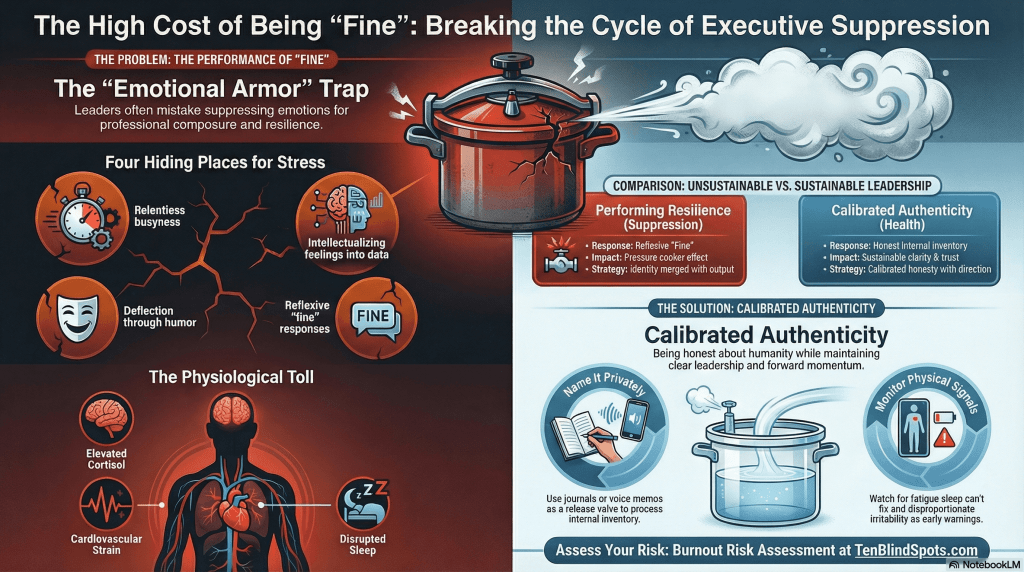
Emotional suppression in leaders rarely looks like what you’d see in a movie. It’s not dramatic stoicism or a blank stare. It tends to look like this:
Staying relentlessly busy. If you never slow down, you never have to sit with discomfort. The calendar becomes a hiding place.
Intellectualizing everything. Turning feelings into data. Instead of admitting anxiety, you run another analysis. Instead of naming fear, you build another contingency plan.
Deflecting with humor. A quick joke cuts the tension and signals to everyone around you that things are under control. Even when they aren’t.
Performing fine. The word “fine” is its own category. It’s the all-purpose emotional lid. It shuts down the conversation before it starts.
If any of those hit close to home, you’re not alone. These patterns show up in executives everywhere. They’re survival mechanisms that worked beautifully in the short term and extracted a brutal cost over time.
The Body Keeps the Score, Even When You Don't
Here’s a concept worth sitting with for a moment.
Trauma doesn’t require a dramatic event. Most people think it does. We associate trauma with headlines, with catastrophic losses, with things that show up in movies.
But trauma, in the clinical sense, is anything your nervous system couldn’t fully process at the time it happened. The public failure where you kept your face neutral but died inside. The restructuring you led that cost people their jobs while you held the company line. The criticism from a board member that landed harder than anyone knew. The marriage that frayed under pressure while you kept showing up to work like nothing was wrong.
Executives are among the most skilled avoiders in the world. We learned early that powering through discomfort got rewarded. So we kept doing it. Decades of shoving experiences aside because there was always another deal to close, another quarter to defend, another fire to put out.
Your body tracked every one of them. It is keeping a ledger you haven’t looked at.
And the C-Suite, with all its visibility and pressure and relentlessness, tends to demand that ledger get settled. Usually at the worst possible time.
The Hidden Price Tag of "Fine"
Here’s what the research tells us, and what my own story confirmed: suppressed emotions don’t disappear. They go underground.
Psychologists sometimes describe it as a pressure cooker effect. Every unexpressed frustration, every swallowed fear, every dismissed wave of grief or inadequacy adds to the pressure. You can manage it for a while. For a long while, even. Leaders are exceptionally good at this.
Until they aren’t.
For me, the moment came at Fort Lauderdale Airport, after my son’s graduation. It was supposed to be a good day. It was a celebration. And I broke down completely. Couldn’t stop crying. Couldn’t explain it. Couldn’t hold myself together the way I had for years.
That wasn’t weakness appearing out of nowhere. That was every “fine” I’d ever said, finally refusing to stay buried.
The physiological toll is real too. Chronic emotional suppression has been linked to elevated cortisol levels, disrupted sleep, impaired immune function, and cardiovascular strain. Your body doesn’t care how many acquisitions you’ve closed. It keeps score whether you want it to or not.
Why Vulnerability Feels Dangerous in the C-Suite
Let’s be honest about why this happens. Vulnerability at the executive level carries perceived risk.
What if the board loses confidence? What if the team starts to doubt the vision? What if showing uncertainty becomes a self-fulfilling prophecy?
Those fears aren’t irrational. Leaders do get watched closely. Emotional signals get interpreted and amplified throughout an organization. There’s a real dynamic at play.
But the answer to that dynamic isn’t to wall everything off. It’s to develop what I’d call calibrated authenticity. The ability to be honest about your humanity while still leading with clarity and direction.
The leaders who build the most durable trust aren’t the ones who never crack. They’re the ones who can say, “This is hard, here’s where we are, and here’s where we’re going.” That combination of honesty and forward momentum is far more stabilizing than a performance of invulnerability.
A Different Way to Lead
When I finally started doing the real work, after burnout had already won that round, one of the first things I had to unlearn was the reflex to suppress.
That didn’t mean processing every feeling out loud in a board meeting. It meant building the internal practices and trusted relationships where honest processing could happen. A therapist. A coach. A handful of peers who understood the terrain.
It meant learning to notice the physical signals before the pressure cooker reached critical levels. The tightness in the chest. The 3 a.m. wake-ups. The gradual flattening of things that used to excite me.
It meant replacing “fine” with something more honest, even if only in private.
In my book, Crash and [Burn] LEARN, I write about this pattern as part of the ten blind spots that lead to burnout. Emotional suppression threads through several of them, most notably what I call Boundary Collapse, Performance-Based Worth, and The Isolation Trap. Leaders who never process their inner world tend to merge their identity with their output, push boundaries until they disappear entirely, and isolate themselves from the very people who could help.
These aren’t character flaws. They’re patterns. And patterns can be interrupted.
What to Do When "Fine" Isn't the Truth
You don’t have to dismantle your composure to start addressing this. A few things that helped me and that I’ve seen help other executives:
Name it, privately. Start with a journal, a voice memo, a trusted friend. You don’t need an audience. You need a release valve. Even five minutes of honest internal inventory before bed can start to shift the pattern.
Find your one safe conversation. Identify one person in your life, whether inside or outside work, with whom you can be genuinely honest. Not for advice necessarily. Just for the experience of saying what’s actually true.
Watch for the physical signals. Emotional suppression tends to show up in the body before it becomes a crisis. Fatigue that sleep doesn’t fix. Irritability that feels disproportionate. A persistent low-level dread. These aren’t signs of weakness. They’re early warnings.
Redefine strength. This is the longest work, and maybe the most important. The belief that suppression equals strength is deeply embedded in most executive cultures. Replacing it with a more accurate model, one where self-awareness and authenticity are competitive advantages, takes time and repetition.
I crashed, and I learned that fine was never really fine. The cost of maintaining that performance was higher than I ever calculated. And the relief of letting it go, even gradually, even imperfectly, was one of the most significant turning points of my professional life.
You don’t have to wait for the airport moment.
If you want to explore where emotional suppression might be showing up in your own leadership, the burnout risk assessment at TenBlindSpots.com is a good place to start. It takes about ten minutes and scores you across each of the ten blind spots that lead to burnout.
Or if you’d rather have a direct conversation, I’m always open to that too.