
The First 90 Days After Promotion: Why Nobody Warns You About the Honeymoon Hangover
I remember the day the announcement went out. New CEO. My name at the top of the org chart. Handshakes, congratulations, a few champagne toasts. I felt like I’d arrived.
What nobody told me? That feeling doesn’t last forever. And what comes next can wreck you if you’re not paying attention.
The Executive Promotion Honeymoon Phase
The honeymoon phase after a big promotion is intoxicating. You’re running on adrenaline, fueled by the validation of being chosen. Every meeting feels charged with possibility. The learning curve is steep, but it’s exciting. You’re proving you belong.
For some executives, this phase lasts 90 days. For others, it stretches much longer. My honeymoon lasted four years. Four years of feeling like I had the perfect job, like everything was clicking, like I could sustain this pace indefinitely. I wasn’t naive. I knew the role was demanding. But I genuinely believed I had found my professional home.
Here’s the thing about honeymoons, though: they all end eventually. And when mine ended, it didn’t taper off gradually. It went from perfect to awful almost overnight.
When CEO Burnout Actually Begins
I call it the Honeymoon Hangover.
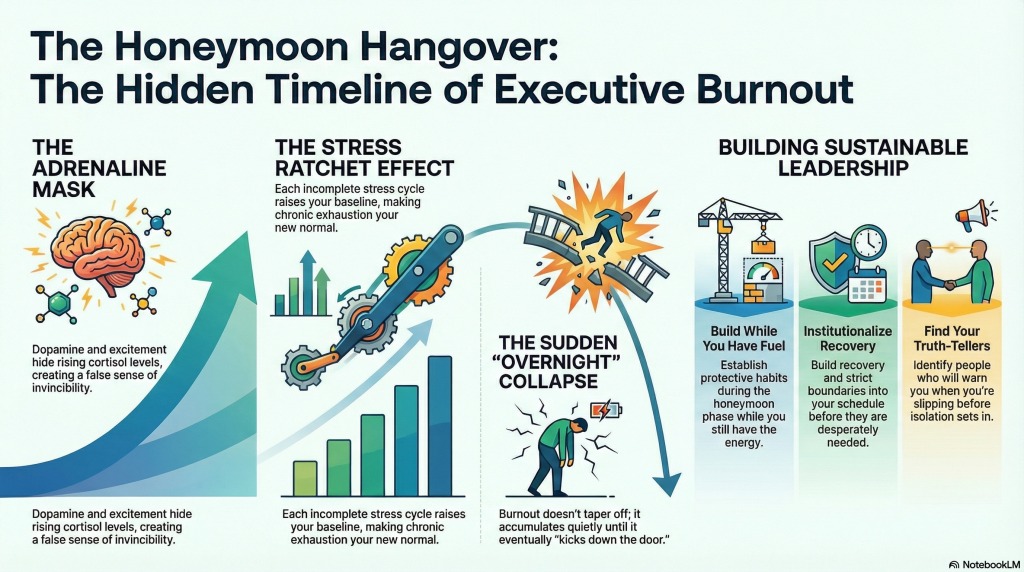
During that initial surge, however long it lasts, your body is doing something remarkable. Cortisol is spiking, yes, but so are dopamine and adrenaline. You’re operating in what feels like peak performance mode. The stress is there, but it’s masked by excitement, novelty, and the genuine thrill of the challenge.
But chronic stress has a ratchet effect. Each incomplete stress cycle leaves your baseline a little higher than before. You adapt to the new normal. The cortisol keeps flowing, but the dopamine rush fades. The meetings that once felt exhilarating become exhausting. The decisions that felt important start to feel endless.
And by the time you notice something is wrong, you’ve been accumulating damage for months. Sometimes years. In my case, four years of accumulated stress came due all at once.
The Hidden Cost of Leadership Transitions
What makes this particularly dangerous is how invisible it feels. You’re performing well. The board is happy. Your team is executing. By every external measure, you’re succeeding.
But internally, something shifts. Sleep gets a little shorter. Exercise drops off. That glass of wine with dinner becomes two. You tell yourself it’s temporary, just until things settle down. Except they never do. At the C-suite level, there is no “settling down.” There’s only the next quarter, the next board meeting, the next crisis.
The longer the honeymoon lasts, the more you convince yourself you’ve figured it out. That you’re different. That the warnings about executive burnout don’t apply to you because you love your job. I told myself that story for four years. And then one morning in Fort Lauderdale Airport, I crumbled completely.
Executive Resilience Starts with Awareness
The executives I coach now, I tell them this: Pay attention during the good times. That’s when the habits form that will either save you or sink you.
Whether your honeymoon lasts three months or four years, the principle remains the same. The good times are when you have the energy, the optimism, and the bandwidth to build protective systems. Waiting until the hangover hits is waiting too long.
Build recovery into your schedule before you need it. Establish boundaries while you still have the energy to enforce them. Find your truth-tellers, the people who will tell you when you’re slipping, before the isolation sets in.
Because the honeymoon phase isn’t a problem in itself. The problem is mistaking it for sustainable. It’s thinking that if you can just maintain this pace, keep this intensity, ride this wave, everything will work out.
It won’t. Not without intentional recovery. Not without systems that protect you from yourself.
What Sustainable Leadership Looks Like
I wish someone had warned me about the Honeymoon Hangover before I experienced it. That’s why I’m warning you now.
If you’re in those early days of a new role, whether you’re 90 days in or still feeling invincible after years, congratulations. Genuinely. You’ve earned this. Now protect it. Build the infrastructure for sustainable performance while you still have the fuel to do it.
Because burnout doesn’t announce itself. It accumulates quietly, in the margins, during the honeymoon phase when you’re too excited to notice. And when it finally arrives, it doesn’t knock politely. It kicks down the door.
I crashed. But you don’t have to.