
The Focus Fallacy: A Confession
I need to tell you something embarrassing.
My entire management model was built around focus. I had read all the books. Good to Great. Blue Ocean Strategy. The One Thing. I could quote Michael Porter in my sleep: “The essence of strategy is choosing what not to do.”
I knew that saying no was the important part of strategy. I preached it. I built decks around it. I had frameworks for prioritization and kill criteria for projects that weren’t making the cut.
And yet.
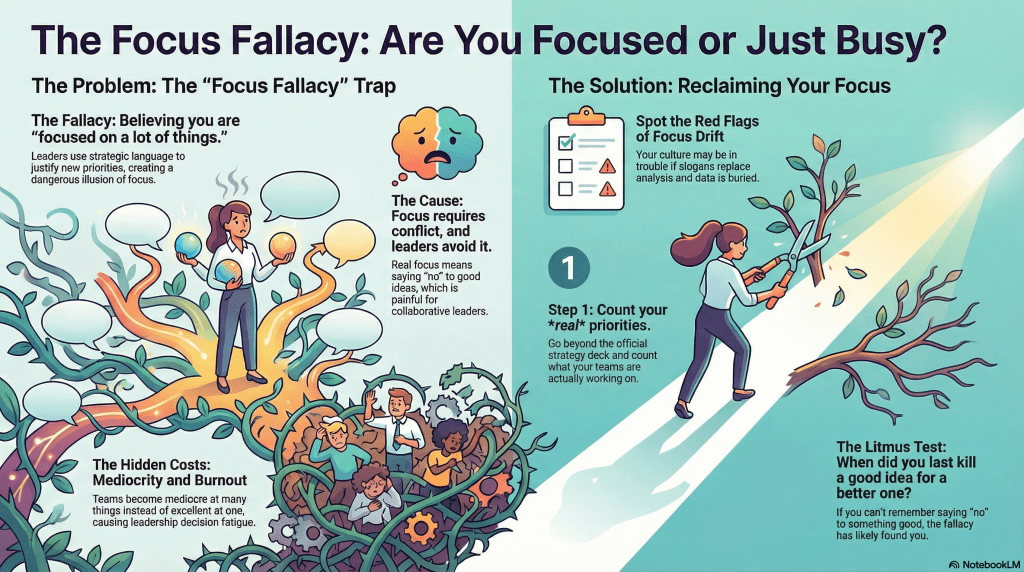
Somehow, I ended up leading an organization where everyone nodded along to the idea that we were focused on a lot of things.
Read that again. Focused on a lot of things. Which is, of course, nonsense. That’s the opposite of focus.
How Executive Burnout Starts With "Just One More Priority"
Here’s the thing about focus drift. It doesn’t announce itself. There’s no moment where you consciously decide to abandon your strategy. It creeps.
It starts with one exception. A board member has a great idea. A customer asks for something slightly outside your core. An acquisition lands on your desk that’s too good to pass up. A talented employee wants to build something new.
Each time, you rationalize. This one makes sense. This opportunity is different. We can handle this alongside everything else.
And because you’re smart, because you’ve read the books, you even dress it up in the language of focus. “This aligns with our strategic vision.” “This is just an extension of what we’re already doing.” “This supports our core priorities.”
Before you know it, your “three key priorities” have become twelve. But everyone still calls them priorities. Everyone still nods in meetings. Everyone still uses the same strategic language.
The illusion of focus remains even as the reality disappears.
Why CEOs Who Know Better Still Fall Into the Focus Trap
I knew the research. Bain & Company found that eighty percent of sustained value creators were built around a single core business. I could point to Apple in 1997, where Steve Jobs eliminated seventy percent of their product line and saved the company. I referenced Wells Fargo’s famous decision to focus on Modesto instead of Tokyo.
But knowing and doing are separated by a canyon.
The uncomfortable truth is that focus requires conflict. Real focus means telling smart people no. It means disappointing stakeholders who have good ideas. It means killing projects that teams have poured their hearts into. It means watching opportunities walk out the door.
And for leaders who built their careers on being agreeable, collaborative, and supportive? That’s excruciating.
So we find ways around it. We expand the definition of “core.” We call everything a “strategic priority.” We convince ourselves that alignment is the same as focus.
It isn’t.
The Hidden Cost of Leadership Drift
The price of this fallacy wasn’t obvious at first. We were busy. We were moving fast. We hit milestones. From the outside, it looked like execution.
But inside, the cracks were forming.
Teams were spread thin across competing priorities. Progress happened everywhere, but excellence happened nowhere. We were mediocre at twelve things instead of exceptional at one or two.
And me? Decision fatigue became my constant companion. When everything is a priority, every decision carries the same weight. There’s no filter. No relief. Just an endless stream of choices that all feel equally important.
That’s exhausting in a way that doesn’t show up on your calendar. It’s the kind of exhaustion that leads to burnout.
Building Resilience in the C-Suite Requires Honest Assessment
Looking back, the warning signs were everywhere.
When your team repeats the same strategy language without actually challenging it, that’s a red flag. When data that contradicts the plan gets softened or buried, that’s a red flag. When decisions get justified with slogans rather than analysis, that’s a red flag. When new ideas are dismissed with “that’s not our focus” without real evaluation, that’s a red flag.
Real talk: I saw some of these signs. I just didn’t want to believe they applied to me. After all, I was the one who built the focus framework. How could I be the one undermining it?
But here’s what I learned the hard way. Tools alone cannot save you. You can have perfect OKRs on paper. You can run monthly portfolio reviews. You can assign devil’s advocates. None of it matters if your culture rewards yes over no.
And culture starts at the top.
Recovery Strategies for Leaders Who've Lost Focus
If any of this sounds familiar, I want you to know something: recognizing the pattern is the first step.
The Focus Fallacy survives because consensus feels safe and clarity feels risky. We mistake harmony for strategy and avoid the discomfort of choosing. Until we narrow the path, effort disperses, drift accelerates, and “alignment” becomes the very thing preventing real focus.
Start by counting. How many priorities does your organization actually have? Not the three you put in the board deck. The real number. The things people are actually working on.
Then ask yourself: when was the last time you killed something good in service of something better? When was the last time you disappointed someone with a no?
If you can’t remember, the fallacy might have found you too.
I’m not sharing this to lecture. I’m sharing it because I wish someone had held up a mirror for me sooner. Maybe this can be yours.
The Focus Fallacy is one of the ten blind spots I explore in my book, Crash and [Burn] Learn: A Business Fable About the High Cost of Burnout, Blind Spots, and the Hope of Recovery. If you want to dig deeper into the patterns that quietly erode leadership effectiveness, the book might be a good place to start.
For more on preventing executive burnout and recognizing blind spots before they derail you, subscribe to Project Crash on LinkedIn:
https://www.linkedin.com/newsletters/project-crash-7395172366567514112