
The Isolation Trap
There’s a moment I remember too clearly.
I was sitting in my office after everyone had left. The parking lot was empty. The building was quiet. And I was staring at a wall of problems I couldn’t tell anyone about.
Not my board. Not my team. Not even my fiancée.
I was the CEO. I was supposed to have answers. I was supposed to be steady. I was supposed to hold it all together.
So I did. Alone. For months. Until I couldn’t anymore.
The Loneliness Nobody Talks About in the C-Suite
Here’s the thing about executive isolation — it doesn’t look like loneliness from the outside.
My calendar was packed. Meetings back-to-back. Calls with investors, vendors, team leads. I was surrounded by people constantly.
And yet I felt completely alone.
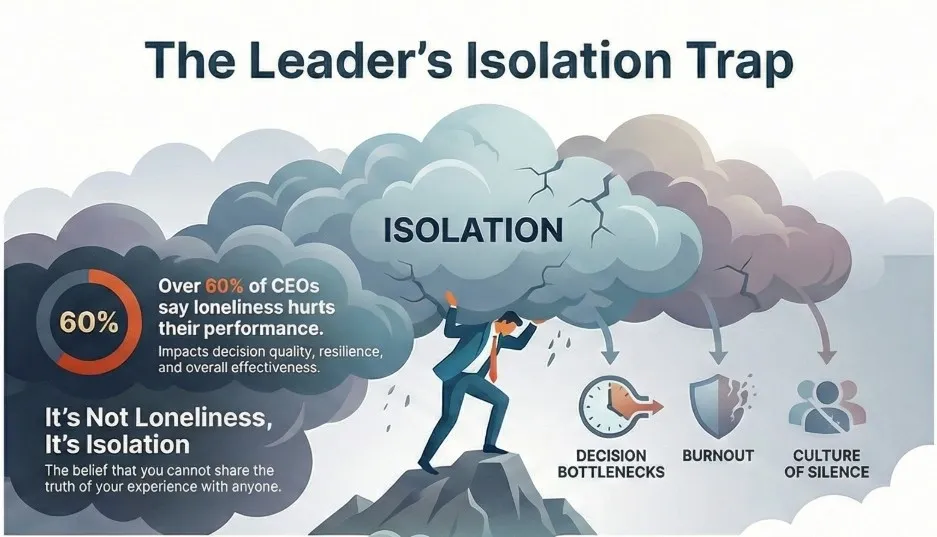
The research confirms what I lived. Half of all CEOs report feeling lonely in their roles. More than sixty percent believe that loneliness actively hurts their performance. Tim Cook once said that being CEO of Apple is “sort of a lonely job.”
He meant it. So do I.
But here’s the distinction that took me too long to understand: loneliness is the feeling of being alone. Isolation is the belief that you cannot share the truth of your experience with anyone.
Most executives aren’t lacking company. They’re lacking connection.
The Atlas Syndrome: Carrying the Sky Alone
In Greek mythology, Atlas is the Titan condemned to hold up the sky for eternity. No breaks. No help. Just endless weight on his shoulders.
That image lives in the bones of every high-achieving leader I’ve ever coached.
We take on more than anyone realizes. We protect our teams from the pressure we carry. We convince ourselves that asking for help would be weak, risky, or impossible.
Responsibility becomes identity. And loneliness becomes the cost of appearing strong.
The internal stories write themselves:
If I don’t hold it together, everything falls apart.
I shouldn’t burden anyone with this.
No one else can handle what I’m carrying.
Strong people don’t need support.
These aren’t thoughts. They’re beliefs wired through years of reinforcement. And they’re killing us.
Why Executive Burnout Starts with Isolation
The spiral is predictable once you see it.
Pressure rises. You take on more. You avoid asking for help. The burden increases. You start withdrawing emotionally. More pressure arrives. Repeat.
Here’s what makes it worse: two-thirds of CEOs don’t receive any external coaching or structured leadership support.
Two-thirds. Of the people in the most demanding roles on the planet.
We talk about resilience. We talk about performance. We talk about decision quality. But we rarely talk about the fact that most leaders are navigating impossible challenges without anyone in their corner.
In 2024, over half of CEOs reported serious mental health challenges — anxiety, depression, burnout symptoms. That’s not a personal failing. That’s a structural crisis.
The Cost of Carrying It Alone
The internal costs are brutal. Emotional exhaustion. Crushed resilience. Psychological numbness. Heightened anxiety. Depression masked as quiet productivity.
But the leadership costs are just as real.
When you isolate, you disconnect from your team. You bottleneck decisions because you can’t delegate what you won’t share. Your people become dependent on your approval because you’ve trained them that you — and only you — can carry the weight.
And the culture follows your lead. Overwork becomes the norm. Asking for help becomes taboo. Isolation spreads because leaders copy leaders.
The person holding the sky becomes the very reason no one else learns to help carry it.
Breaking Free from the Isolation Trap
I wish I could tell you there’s a quick fix. There isn’t.
But I can tell you what started to change for me.
I stopped pretending I had all the answers. I found a coach who could hold space for the truth I couldn’t tell anyone else. I started naming the weight instead of hiding it.
Connection isn’t a burden. It’s the only thing strong enough to share the load.
Real talk: you weren’t built to carry the sky alone. No one is.
The strongest leaders I know aren’t the ones who never ask for help. They’re the ones who learned that asking for help is what makes them strong.
If this resonates, I’d love to hear from you.
I’m building a community of executives who are done pretending everything is fine. Leaders who want to perform at the highest level without sacrificing their wellbeing in the process.
Ready to put down some of that weight? Let’s talk.
Book a discovery call: calendly.com/jgodbarge-gemconsultingsolutions/ten-blind-spots-discovery-call
Learn more: CrashandBurn-LEARN.com