
The Judgment Trap: Why Your Brain Keeps Betraying Your Best Intentions
Most executives I work with have developed solid emotional intelligence over the years. They’ve learned to pause before firing off that angry email. They know better than to snap at a direct report in front of the team. They’ve trained themselves to take a breath when someone pushes their buttons in a meeting.
And they think that means they’ve escaped the judgment trap.
They haven’t. They’ve only escaped the obvious version.
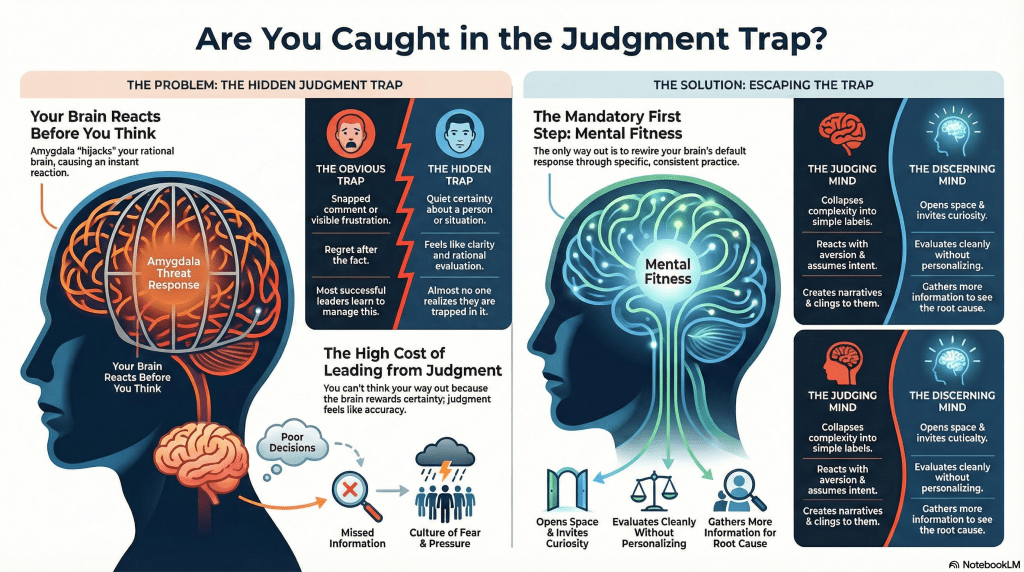
Here’s the thing: there are two types of judgment that derail leaders. The first is dramatic, the snapped comment, the visible frustration, the reaction you regret before the meeting even ends. Most successful executives have learned to manage this one. It’s the price of admission to the C-suite.
But the second type? It’s quieter. Slower. And far more dangerous. It doesn’t look like an outburst. It looks like certainty. Like clarity. Like truth.
And almost no one realizes they’re trapped in it.
When Your Brain Decides Before You Do
There’s a moment, often so quick you barely notice it, when your brain decides how you’ll respond to a situation. It happens long before you have time to think. A look from a board member. A curt email. A hesitation in someone’s voice. Something lands wrong, and your body reacts before your mind catches up.
Neuroscience has mapped this with remarkable clarity. The amygdala, the part of your brain wired for threat detection, fires almost instantly. It was designed for survival in a very different world. One where hesitation meant danger. Physical danger. Life-ending danger. So the amygdala learned to react first, question later.
In a leadership context, this ancient response becomes problematic.
While your amygdala is sounding an alarm, your prefrontal cortex, the part of your brain responsible for nuanced thinking, analysis, and judgment, momentarily goes offline. Daniel Goleman called this an amygdala hijack, and the description feels accurate. Something in you has taken the wheel, and your better judgment hasn’t been invited along for the ride.
The Quieter, More Dangerous Version
The dramatic version of the judgment trap is the one you recognize afterward. The snapped comment. The meeting you wish you’d handled differently. The reaction that felt justified in the moment but regrettable in hindsight.
But the more dangerous version is quieter. It doesn’t look like an outburst. It looks like certainty. Like these examples:
A belief about someone’s competence that calcifies over time. A story you tell yourself about a colleague’s motives. A conclusion about a team’s capability that you never revisit. A suspicion that becomes fact simply because you’ve rehearsed it mentally long enough.
This slow, chronic version of judgment is harder to detect because it doesn’t feel like reactivity. It feels like clarity. You think you’ve evaluated the situation rationally. But what you’re really seeing is your own emotional residue, hardened into an assumption.
The Difference Between Judgment and Discernment
Buddhist psychology has studied this dynamic for centuries and offers a useful distinction. The judging mind reacts with aversion. It labels. It condemns. It clings to narratives long after the moment has passed.
The discerning mind, by contrast, sees without attachment. It evaluates cleanly. It gathers information without personalizing it. It can say, “This isn’t working,” without slipping into, “They are the problem.”
The difference is profound.
Judgment collapses complexity. It reduces people to caricatures. It assumes intention without inquiry. Discernment opens space. It invites curiosity. It asks what else might be true. It recognizes that behavior is often a symptom, not the root.
The Real Cost to Your Leadership
The research is unequivocal. When executives operate from emotional reactivity, their decision quality declines. Their ability to see nuance deteriorates. They miss critical information. They misread intent. They create atmospheres where people withhold truth because the emotional cost of honesty feels too high.
Cultures shaped by judgment tend to be fast-moving on the surface but brittle underneath. They run on pressure instead of clarity. Fear instead of curiosity. Correction instead of learning. In these environments, leaders are constantly reacting to symptoms instead of addressing causes, and organizations burn immense energy managing emotional fallout rather than making strategic progress.
And here’s the part that stings: the Judge doesn’t just target others. It turns inward too. It tells you that you should have known better. That you should always be composed. That any misstep confirms something defective about you. This is where leaders get stuck, in the exhausting loop of judging others and then judging themselves for judging others.
Why "Trying Harder" Doesn't Work
Here’s the real talk: You cannot think your way out of the judgment trap.
Self-correction fails because judgment feels like accuracy. The brain rewards certainty. Reactivity feels justified because emotion mimics insight. The story forms before awareness. By the time you notice, you’re already inside the judgment. Slowing down feels unnatural because your nervous system wants resolution, not reflection.
You confuse speed with clarity. The faster the judgment, the more confident it feels.
This is why all the leadership books in the world won’t fix this. Why meditation apps alone won’t fix this. Why sheer willpower won’t fix this.
The judgment trap is wired into your neurobiology. And rewiring requires more than understanding. It requires practice. Specific, consistent, targeted practice that actually changes how your brain responds in real-time.
The Mandatory First Step
When I work with executives, the judgment trap is almost always present. Not because they’re bad leaders, but because they’re human beings with high-performing brains that have been running on adrenaline and survival mode for years.
What I’ve discovered is that there’s a foundational skill that has to come first. Before we can work on leadership presence, strategic clarity, or relationship repair, we have to address the operating system itself. We have to rewire the brain’s default responses.
I use a mental fitness training program as the foundation of my coaching work. It’s not a nice-to-have. It’s the mandatory first step. Because until leaders can interrupt the judgment reflex, until they can slow the mental storm long enough for their prefrontal cortex to re-engage, everything else is just rearranging deck chairs.
The program teaches you to catch judgment in real-time. Not after the damage is done, but in the actual moment when your amygdala fires. It trains your brain to shift from reactivity to discernment, from certainty to curiosity, from the Judge to what I call the wiser, clearer version of yourself.
Something shifts when leaders learn this skill. Discernment returns. Options reappear. Conversations broaden. Leaders begin to see the person instead of the projection, the system instead of the story, the possibility instead of the threat.
The difference between judgment and discernment is not intelligence. It is not experience. It is not personality.
It is the state of the mind you’re using in the moment.
And most leaders do not realize how often they’re making decisions from the wrong mind.
Ready to Discover a Different Way?
If you recognize yourself in any of this, if you’ve felt the tightness in your chest, the quick conclusions, the certainty without evidence, the exhausting loop of judging and being judged, I want you to know there’s a way out.
The mental fitness program I use with my clients has been transformational. Not incrementally helpful. Transformational. Leaders who thought they’d tried everything finally find the leverage point that makes sustainable change possible.
I’d love to tell you more about it. Schedule a discovery call with me, and let’s explore whether this approach might be the missing piece you’ve been looking for.
Because here’s what I learned the hard way: understanding the judgment trap doesn’t free you from it. Only practice does. And the right practice changes everything.
Ready to stop the judgment loop and lead from clarity instead of reactivity? Schedule a discovery call and let’s talk about the mental fitness foundation that could change how you show up as a leader.
Subscribe to Project Crash for more insights on preventing executive burnout before it starts: https://www.linkedin.com/newsletters/project-crash-7395172366567514112