
The Knowledge Nobody Wrote Down
I still remember the plant tour.
We were walking the floor at “Atlas Manufacturing” in Tennessee — me, Don, Chester — doing what acquirers do. Noting the equipment. Clocking the layout. Mentally flagging the inefficiencies. Richard, the founder, was walking us through every station with the quiet pride of a man who had built something real over decades.
I was focused on the wrong things.
I saw aging motors. Maintenance logs that showed improvisation. A floor that, in my estimation, needed a new spine. I was mentally calculating upgrade costs, integration timelines, powder-coating lines. I was doing acquisition math while Richard was trying to show me something I didn’t have the eyes to see.
Every person on that floor knew exactly what to do.
Not because it was written somewhere. Not because there was a manual. Because they had learned it — from each other, from years of repetition, from standing shoulder to shoulder and figuring things out in real time. That knowledge lived in them. And when we later had to recreate what Atlas produced internally? We found out the hard way just how expensive invisible knowledge really is.
What Dan Wang Called It
I picked up Dan Wang’s book Breakneck: China’s Quest to Engineer the Future recently, and something in the early chapters stopped me cold.
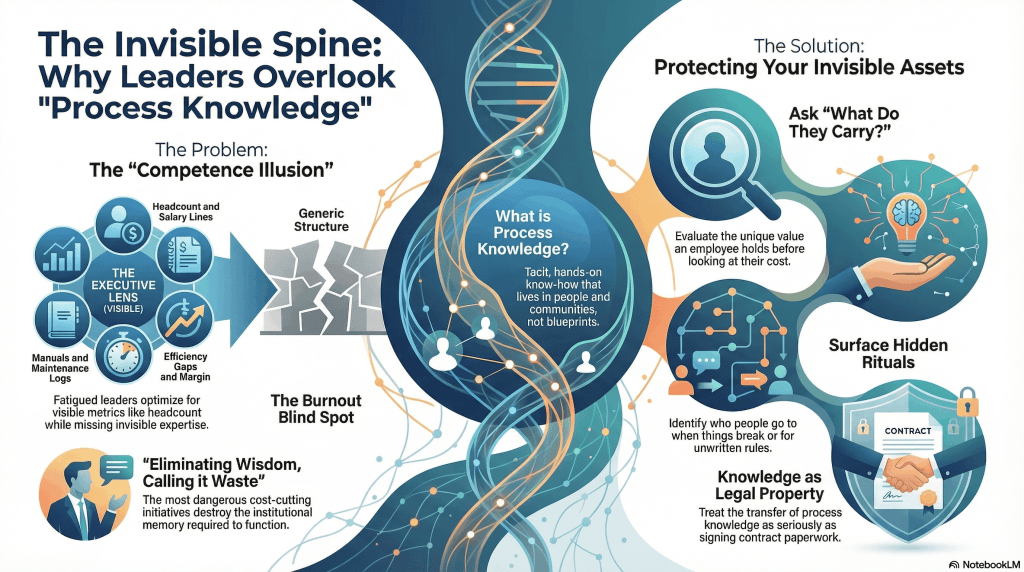
Wang introduces the concept of “process knowledge” — described as the tacit, cumulative, hands-on know-how that accrues on factory floors, in long supply chains, in communities of practice built over time. It’s the kind of knowledge you can’t fully capture in a blueprint or a manual. It lives in the doing. It transfers person to person, shift to shift, generation to generation.
Wang argues that this is one of China’s most significant competitive advantages. Decades of building things — starting with socks, moving to shoes, scaling to iPhones and batteries — created layers of embedded expertise that competitors struggle to replicate. Not because the technology is secret. Because the knowledge is embodied.
Reading that, I thought about Richard.
I thought about all the things I walked past on that tour.
What Jason Marchand Missed
Jason Marchand — the fictional CEO at the center of my book Crash and [Burn] LEARN — makes a version of this mistake during the Atlas acquisition. When he tours the floor, his lens is purely financial. Efficiency gaps. Capital needs. Margin potential.
Richard, the founder, is proud. Not of the machinery. Of his people.
Jason doesn’t quite see it. He’s running acquisition math. He’s thinking about leverage and exit multiples. He sees a place that needs a new spine, not a place that has built one — invisible, human, irreplaceable.
That blind spot costs him. When the supply relationship with Atlas eventually collapses and Jason’s team has to produce what Atlas made, they discover that knowing what a product is and knowing how to make it are two very different things.
The gap between them? Process knowledge.
The Executive Version of This Problem
Here’s the thing. Most executives aren’t buying manufacturing plants. But the same dynamic plays out in boardrooms, in mergers, in restructuring, in “optimization” initiatives of all kinds.
We look at headcount and see cost. We look at long-tenured employees and see salary lines. We look at informal rituals — how a team runs a morning standup, how a client relationship gets managed, how a complex deal gets navigated — and we see inefficiency.
What we often miss is what those people carry.
It’s not on the org chart. It doesn’t show up in a competency framework. It doesn’t transfer cleanly in an offboarding document. It’s the answer to “why do we do it this way?” — a question that, asked of a 20-year veteran, takes an hour to answer properly. Asked of a new hire after that veteran is gone? You get a shrug.
Real talk: the most dangerous cost-cutting initiatives aren’t the ones that eliminate waste. They’re the ones that eliminate wisdom while calling it waste.
Why Burned-Out Leaders Are Especially Vulnerable to This
This is where it connects directly to burnout.
When we’re running on fumes — when the ten blind spots that lead to burnout have quietly taken hold — our judgment narrows. We optimize for what’s visible and measurable. Speed. Cost. Headcount ratios. We lose patience for the slow, relationship-based, hard-to-quantify things.
The Competence Illusion — one of those ten blind spots — is particularly relevant here. It’s the pattern of confusing knowledge about something with the ability to actually do it. Or in this case, confusing a financial model of an operation with a real understanding of how it works.
I’ve lived this. When I was deep in the roll-up strategy, acquiring company after company, I was running fast on information and short on wisdom. I thought understanding the numbers meant understanding the business. It didn’t.
The things that kept companies running — the institutional memory, the earned trust, the tacit expertise — those were the things I was least equipped to value when I was most depleted.
What You Can Do About It
This isn’t a call to stop making hard decisions. Businesses need to evolve, restructure, and sometimes shrink.
But here’s what I’ve learned, and what I now help executives see:
Ask “what do they carry?” before you ask “what do they cost?” Before any significant structural change, try to surface the process knowledge in the room. Who are the people others go to when something breaks? Who holds the client relationships that live nowhere in the CRM? Who can answer the question your newest team member can’t even think to ask yet?
Slow down enough to see it. Burnout and overload make us speed past what matters. The plant tour where Richard was showing Jason something real — Jason almost missed it entirely because he was moving too fast and thinking too narrowly.
Build transfer into transitions. If someone leaves — willingly or not — treat knowledge capture as seriously as contract paperwork. It rarely is. It should be.
And recognize when you’re in the Competence Illusion. Knowing about something is not the same as understanding it. Ask more questions. Sit on the floor, metaphorically or literally.
The Real Cost of Invisible Knowledge
Wang’s argument in Breakneck is that America’s drift away from manufacturing wasn’t just a loss of jobs. It was a loss of process knowledge — a slow erasure of the embedded, generational expertise that makes certain things possible at scale. Once gone, it takes decades to rebuild. If it can be rebuilt at all.
The same is true inside companies.
The people who carry invisible knowledge are often not the loudest voices in the room. They’re not always the ones with the most impressive titles or the sharpest PowerPoints. They’re the ones who know why the system works the way it does — and what breaks first when you touch the wrong thing.
Richard knew that. He was trying to show Jason.
Jason was busy calculating.
Don’t be Jason on the floor tour. Slow down. Look at what’s actually there.
Because the day you have to recreate what you walked past? That’s the day you realize what it was worth.
Ready to explore your own blind spots before they become expensive? I crashed so you don’t have to. Let’s talk.