
The Lie That Almost Destroyed Me: Why the C-Suite Won't Make You
I spent two decades chasing a seat at the table. Every promotion, every late night, every missed family dinner—all investments in a future I was certain would pay off.
Then I got the CEO title.
And I was thrilled. Proud. Energized. I toasted with my fiancée over champagne. I felt like everything I’d sacrificed had finally been worth it.
That feeling lasted about four years for me.
Then something shifted. The excitement faded. The wins stopped landing the way they used to. I found myself chasing the next deal, the next acquisition, the next milestone—not because I was building something, but because I was trying to recapture a feeling that kept slipping away.
Here’s the thing about high performers like us: we love a finish line. We’re wired to believe that happiness lives somewhere out ahead. Waiting. Hiding behind the next title, the next deal, the next shiny milestone.
It’s a seductive lie. And I believed it completely.
The Honeymoon Phase Nobody Warns You About
When you finally land that C-suite role, the high is real. You’ve earned it. The recognition feels incredible. For a while, everything seems to confirm that you made the right sacrifices.
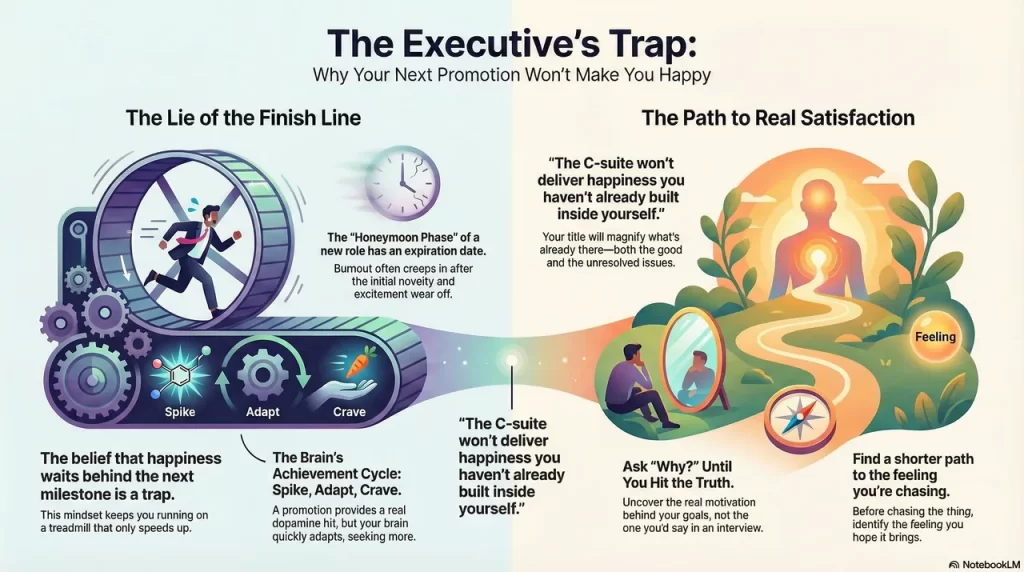
But here’s what nobody tells you: that honeymoon phase has an expiration date.
Research shows burnout rarely hits in the first year of a new role. It creeps in later—once the novelty wears off, once the challenges compound, once you realize the title didn’t actually fix what felt unsettled inside you.
It won’t. It just delays the reckoning.
Why Your Brain Keeps Moving the Goalpost
Let’s get practical for a moment.
Pleasure has a predictable pattern in the brain. Dopamine floods your system when you get something delightful. It spikes. It feels amazing. Then it drops—often below baseline.
That drop is where craving comes from.
The hit from the promotion is real. The corner office really does feel great—at first. But the brain adapts. What felt like arrival becomes the new normal. And suddenly you’re scanning the horizon for the next thing that might bring back that feeling.
I watched my entire career get built on that misunderstanding. Each win bought me maybe six months of satisfaction before the restlessness returned.
The Question Behind Every Goal
This isn’t about moralizing. It’s about stopping the self-deception around why we want certain things.
Every goal hides a deeper reason. Sometimes beautiful. Sometimes not.
Two people can want the exact same thing for completely different motives:
One wants a boat because the water is their sanctuary. The other wants a boat because the executives they admire all have one at the marina.
Same purchase. Very different paths. Only one leads to actual satisfaction.
That’s why I started using the “Russian Doll” approach with my clients. Keep asking why until you hit the truth. Not the glossy reason you give in job interviews. The real one.
Why do you want that C-suite title? Why do you think it will make you happy? And why is that?
Keep peeling. Eventually you’ll hit the core. It might surprise you.
The Brutal Truth About Executive Happiness
Here’s what nobody told me—and what I wish someone had said while I was still in the honeymoon phase:
Happiness isn’t waiting at a future milestone. You already carry everything you need to be happy today.
That’s uncomfortable for achievers like us because it removes the illusion that “the next thing” will fix whatever feels off. If you don’t have food or housing security, future improvements really can shift happiness. But if you’re reading about CEO burnout, that’s not your situation.
The C-suite won’t deliver happiness you haven’t already built inside yourself. It may amplify what’s already working. But it will definitely magnify whatever you haven’t dealt with.
I was proud when I got the title. Genuinely proud. But that pride couldn’t sustain me once the deeper cracks started showing. By the time I was standing in an airport unable to stop crying, I finally understood: the promotion had been real, but the promise behind it was always a lie.
What This Means For You
The belief that reaching the top will make you happy is the first false belief—and it sets up all the others. It keeps you running on a treadmill that speeds up every time you hit a new pace.
Wanting isn’t the problem. Believing happiness lives on the other side of achievement is.
So here’s my invitation: Before you chase the next milestone, pause. Ask yourself what you’re really after. Is it the thing itself? Or the feeling you hope it will bring?
Because if it’s the feeling, there might be a shorter path to get there. One that doesn’t cost you your health, your relationships, or your sense of self.
I crashed so you don’t have to. But that only works if you’re willing to question the lies that kept me running until I couldn’t run anymore.
This is the first in a series on the Five False Beliefs that quietly drive executive burnout. If this resonated, stay tuned—or reach out. I’ve been where you are, and there’s a better way forward.