
The Oscar-Worthy Performance That's Killing You
Hey there,
I used to be magnificent at Success Theater.
Board meetings? Standing ovation performance. Investor calls? Five stars. Company all-hands? Academy Award material.
Meanwhile, backstage? Towards the end it was brutal and I was struggling. But nobody knew. Because I’d perfected the art of looking successful while drowning.
Sound familiar?
The Success Trap Defined
Here’s the dirty secret of executive life: Things might look great from the outside, but there could very well be something rotting on the inside.
The Success Trap is that special kind of hell where your LinkedIn looks perfect, your quarterly numbers hit targets, and everyone thinks you’ve got it all figured out. Meanwhile, you’re held together with caffeine, anxiety meds, and the desperate hope that nobody looks too closely.
It’s the trap where image management becomes more important than actual management. Where looking good replaces being good. Where we spend more energy maintaining the facade than fixing the foundation.
And here’s the kicker: the more successful you appear, the harder it becomes to admit you’re struggling.
Why We're All Method Actors
Let’s be honest about why we do this:
Fear. Pure, simple, executive fear.
Fear that admitting struggle equals admitting failure. Fear that showing cracks means showing weakness. Fear that if people knew the truth, the whole thing would collapse.
So we perform. We perfect our “everything’s great” smile. We master our “exciting challenges ahead” speech. We become so good at pretending that we forget we’re pretending.
The research on this is sobering:
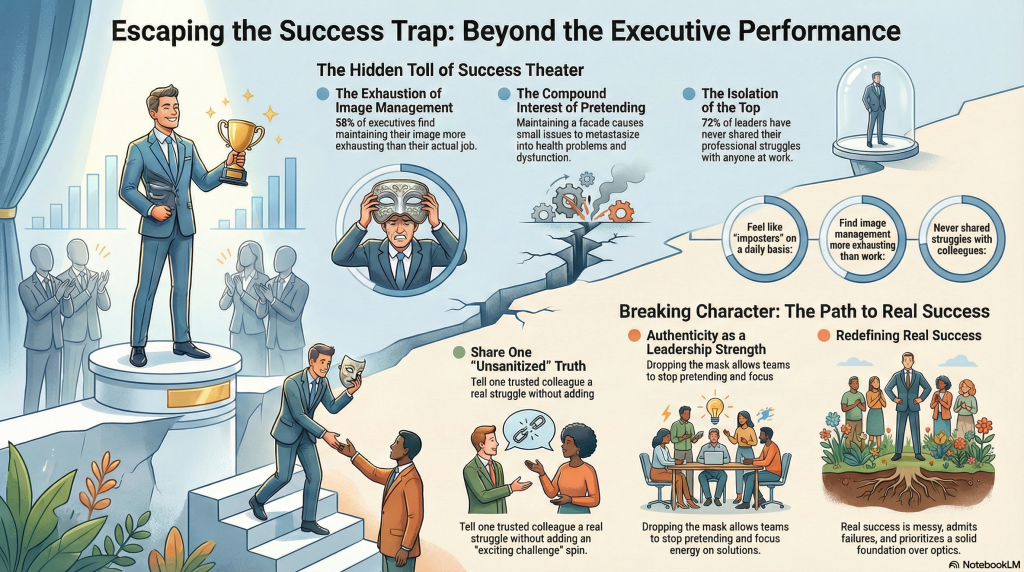
- 67% of executives report feeling like “imposters” daily
- 58% say maintaining their image is more exhausting than their actual job
- 72% have never told anyone at work about their struggles
We’re all actors in the same play, too scared to break character.
The Compound Interest of Pretending
Here’s what nobody tells you about the Success Trap: It compounds.
Every day you pretend things are fine, it gets harder to admit they’re not. Every time you perform “successful executive,” the gap between image and reality widens. Every moment you spend managing perception is a moment not spent managing problems.
And problems don’t go away just because you’re ignoring them. They metastasize.
That small team issue you’re too “successful” to address? It becomes departmental dysfunction. That stress you’re too “strong” to acknowledge? It becomes chronic health issues. That disconnect you’re too “busy” to mention? It becomes divorce papers.
Breaking Character (Before the Show Closes)
The day I finally broke character wasn’t planned.
I waited too long, and my body finally told me in no uncertain terms that “we” needed a break. I ended up sobbing uncontrollably and without much of a clue why I couldn’t control my mind, and barely could harness the strength to go board my plane.
The Power of Dropping the Mask
Here’s what I learned: Authenticity is not weakness. It’s the ultimate strength.
When you stop performing success and start pursuing it honestly:
- Your team stops pretending too
- Problems get addressed instead of hidden
- Energy goes toward solutions, not theater
- You become a leader people trust, not just applaud
Your Exit from the Theater
This week, try this:
Pick one person: a trusted colleague, advisor, or friend. Tell them one true thing about your current struggle. Not the sanitized version. Not the “exciting challenge” spin. The real thing.
Watch what happens when you stop performing and start being.
Warning: It’ll feel like walking onstage naked. Do it anyway.
The Truth About Success
Real success doesn’t need a performance. It doesn’t require perfect optics or polished presentations or pretending everything’s fine.
Real success is messy. It includes struggles. It admits failures. It asks for help.
The Success Trap nearly killed me, literally. The performance became so exhausting that collapse wasn’t just possible; it was inevitable.
Your show doesn’t have to end like mine did.