
The Power of Naming Things
Something unexpected happened when I started writing my book.
I didn’t just learn about publishing or the business fable genre or how to structure a manuscript. I was reminded of something about the human mind that changed how I think about coaching, leadership, and recovery.
Something I already knew but had somehow forgotten along the way.
Naming something gives you power over it.
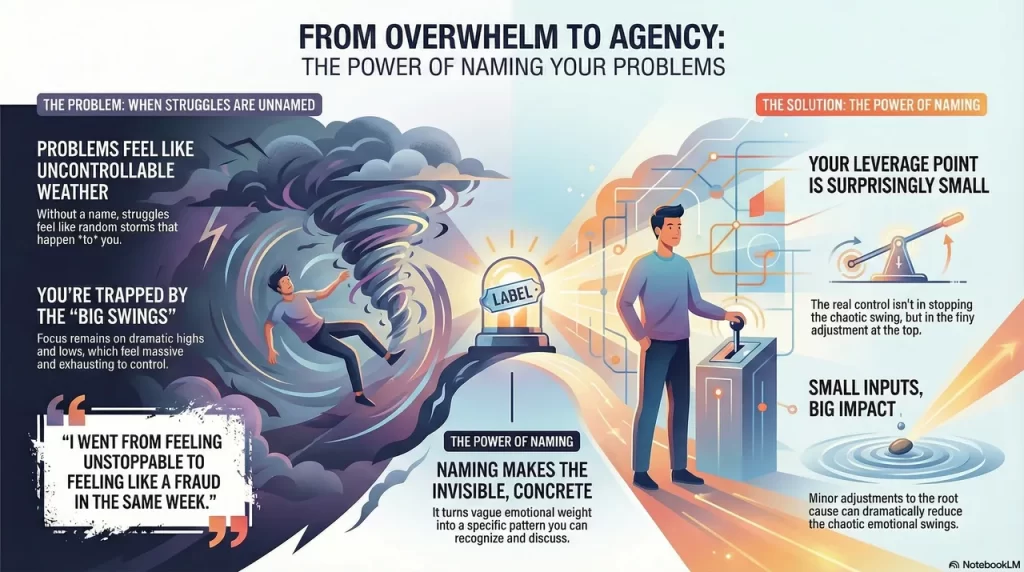
When Problems Feel Like Weather
Before I had language for what I was experiencing, burnout felt like weather. Something that just happened to me. A storm that rolled in, wrecked everything, and left me standing in the debris wondering what went wrong.
I could describe the symptoms. The exhaustion. The irritability. The 3 AM wake-ups. The sense that I was performing a version of myself that wasn’t real anymore.
But describing symptoms isn’t the same as understanding what’s driving them. And without that understanding, I was stuck reacting to the chaos instead of addressing its source.
The Moment Everything Clicked
When I started developing the Ten Blind Spots framework, something shifted.
Suddenly the fog had structure. The invisible patterns that had been running the show finally had names. The Denial Tax. The Isolation Trap. The Confidence Pendulum.
And here’s the thing: once I could name them, I could talk about them. Not just with my coach or therapist, but with other executives. People who immediately recognized themselves in the language.
“That’s exactly what I’m dealing with.”
“I didn’t know there was a word for that.”
“I thought I was the only one.”
Naming problems doesn’t solve them automatically. But it does something equally important. It makes them discussable. It makes them concrete. It transforms vague emotional weight into something you can actually work on.
Why Pendulums Keep Showing Up in My Thinking
Last week I wrote about the Confidence Pendulum, that exhausting swing between “I’ve got this” and “I’m about to be exposed.” Since then, I can’t stop thinking about pendulums as a metaphor.
Not just for that specific blind spot, but for how naming things changes our relationship with problems entirely.
Here’s what I’ve noticed. When people describe their struggles without a framework, they tend to focus on the swings. The dramatic moments. The highs and the lows that feel overwhelming and impossible to control.
“My confidence collapsed after that board meeting.”
“I went from feeling unstoppable to feeling like a fraud in the same week.”
“I can’t control these emotional swings.”
When you’re focused on the swings, the problem feels massive. The pendulum is traveling huge distances. The emotional journey from one extreme to the other is exhausting. And worst of all, it feels completely out of your control.
But Here's the Thing About Pendulums
The swing at the bottom might travel a long distance.
But the motion at the top? Where you’re holding the string? It’s just a few degrees.
That’s the insight that changes everything.
When you name the pattern and see it clearly, you stop trying to control the dramatic swings at the bottom. You realize you’re not powerless at all. You’re just focused on the wrong part of the system.
The leverage point isn’t down where all the chaos is happening. It’s up at the pivot point. And the adjustment you need to make there is surprisingly small.
What This Means for Real Change
Think about the Confidence Pendulum again.
The swings at the bottom feel enormous. One day you’re certain you’re crushing it. The next day you’re convinced everyone’s about to figure out you don’t belong. The emotional distance between those two states is massive.
But what’s actually driving it? A few degrees of identity instability at the top. A tendency to tie your self-worth to outcomes. An overactivation of reward and threat circuits based on external feedback.
Small inputs. Big swings.
Which means small adjustments at the right point can dramatically reduce the chaos you experience.
That’s empowering.
That’s actionable.
That’s why naming matters.
From Overwhelm to Agency
The executives I work with often come to me feeling like they’re drowning in problems they can’t articulate. They know something is wrong. They can feel the damage accumulating. But they can’t point to it clearly enough to address it.
When we name the patterns together, something shifts in their posture. Their shoulders drop. They exhale.
“I can work with that.”
It’s not that the problem disappears. It’s that it becomes workable. It moves from “this overwhelming force that’s happening to me” to “this specific pattern I can learn to recognize and adjust.”
The pendulum is still there. It might always be there.
But now you know where to grab the string.
The Naming Game
Writing this book taught me that language isn’t just description. It’s equipment.
When you have words for the patterns that drive burnout, you can catch them earlier. You can discuss them without shame. You can build systems around them. You can teach others to recognize them.
And maybe most importantly, you can stop feeling crazy for experiencing something that millions of high-performing leaders experience but rarely talk about.
Because once it has a name?
It’s not just your private struggle anymore.
It’s a pattern. A human one. One that can be understood, discussed, and ultimately changed.
I crashed, but you don’t have to.
Ready to name the patterns that might be running the show in your leadership? Let’s have a conversation.(calendly.com/jgodbarge-gemconsultingsolutions/ten-blind-spots-discovery-call)