The Precision Trap: Why I Wrote a Fable Instead of a Business Book
I am a huge fan of Nassim Nicholas Taleb.
His book The Black Swan is one of those rare works that delivers profound insights wrapped in a dry, almost sardonic wit. That combination is hard to pull off. Most authors can do one or the other. Taleb does both, and he does it while making you question everything you thought you knew about risk, prediction, and expertise.
I recently came across a quote from the book that stopped me cold:
“They wanted to be wrong with infinite precision, rather than being approximately right, like a fable writer.”
And I thought: that is exactly why I wrote a fable.
The Seduction of Precision in the C-Suite
Taleb is critiquing the experts, the analysts, the executives who build elaborate predictive models that generate precise-looking forecasts. Q3 revenue will be $47.3 million. Customer churn will decrease by 12.7%. The integration will achieve synergies of exactly $8.2 million by month eighteen.
These numbers create an illusion of control and certainty. They look rigorous. They feel scientific. They give us something concrete to put in the board deck.
But here is the thing: precision is not the same as accuracy.
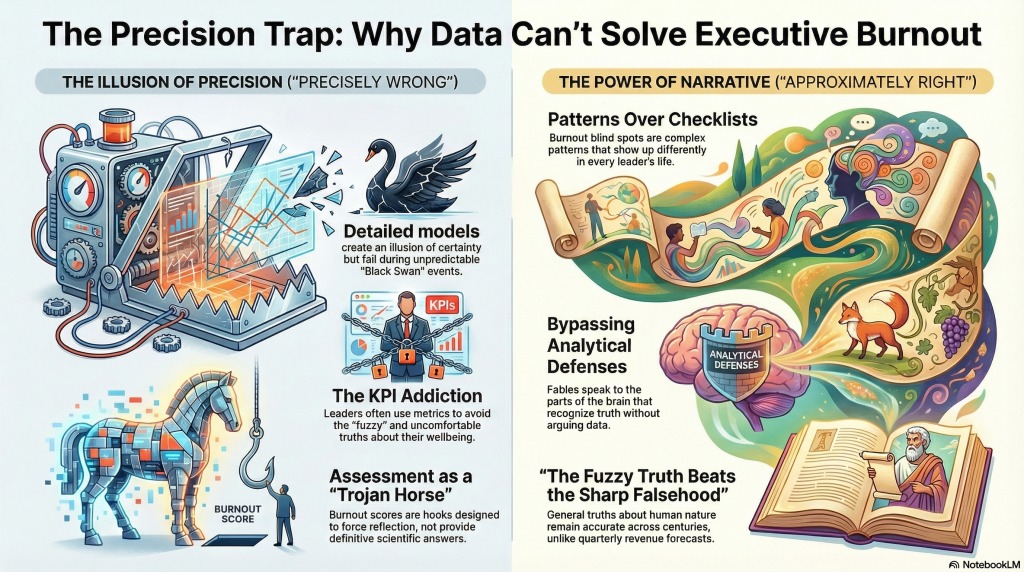
You can be precisely wrong. Your spreadsheet predicts $47.3 million, reality delivers $12 million. Or $89 million. The model was detailed, sophisticated, and completely useless when a Black Swan event arrived. A pandemic. A market crash. A key executive walking out the door.
What the Fable Writer Knows About Executive Burnout
Meanwhile, a fable writer deals in general truths about human nature. “Pride comes before a fall.” “Do not put all your eggs in one basket.” These are not precise. You cannot plug them into a spreadsheet. But they are approximately right across centuries and situations.
When I sat down to write Crash and [Burn] LEARN, I had a choice. I could have written a traditional business book. Frameworks. Case studies. Statistics. Fourteen steps to sustainable leadership. A burnout risk assessment with percentile rankings.
I chose the fable instead.
Not because I could not do the data. After years in private equity, I can build a model with the best of them. I chose the fable because I understood something that my breakdown at Fort Lauderdale Airport taught me: the executives who need this message most are often the ones most addicted to precision.
When Precision Becomes a Blind Spot
They want the exact protocol. The specific metric. The definitive answer. “Just tell me the five steps to avoid burnout.”
But burnout does not work that way. Recovery does not work that way. The ten blind spots that lead to burnout are not a checklist. They are patterns that show up differently in every leader’s life. The Denial Tax looks different for a founder than it does for a newly promoted COO. The Confidence Pendulum swings differently depending on whether you are eighteen months into a turnaround or three years into a slow decline.
A fable honors that complexity. It says: here is a story that is approximately right about how this unfolds. See yourself in it. Draw your own connections.
The Power of Approximately Right
The fable form does something that no amount of precision can accomplish. It bypasses the analytical defenses we build up. It sneaks past the part of our brain that argues with data and speaks directly to the part that knows.
You do not need to remember that “67% of executives experience burnout symptoms within 18 months of promotion.” You remember Jason’s journey. You feel the slow accumulation of blind spots. You recognize yourself in the narrative.
That recognition is worth more than any precisely wrong statistic.
The Meta-Lesson for Leaders
There is a deeper lesson here, and it goes beyond books.
We measure quarterly results to two decimal places but ignore the imprecise signals our bodies send us. We want a precise burnout score rather than listening to the approximate truth: you are running on empty and something has to give.
Full disclosure: I actually built a burnout risk assessment that gives you a score for each of the ten blind spots. I know exactly what I am doing. Executives love KPIs, so I gave them KPIs. But here is my confession: the scores are not the point. They are the hook. What matters is that you engaged with the questions. That you paused long enough to consider whether the Denial Tax might be showing up in your life. The precision is a Trojan horse for reflection.
The obsession with precision might itself be a blind spot. A way to avoid the fuzzy, uncomfortable truths that do not fit neatly into a dashboard. A way to feel in control when control is an illusion.
Taleb understood something that most business writers miss. The fable writer’s fuzzy truth beats the analyst’s sharp falsehood. Every time.
That is why I wrote a fable. Because some truths are too important to be precise about.
I crashed, but you do not have to.