
The Scar You Keep Promoting
I want to tell you something I wish someone had told me when I first got the CEO title.
All those things you’ve been carrying, the promotions that didn’t happen, the projects that blew up, the moments you froze in a meeting and never forgave yourself for, the failures you replay at 2am, they did not disappear when you got the corner office.
They got a bigger stage.
The Promise We Make Ourselves on the Way Up
Most high performers run on a quiet, invisible contract. You may not have written it down, but you know exactly what it says.
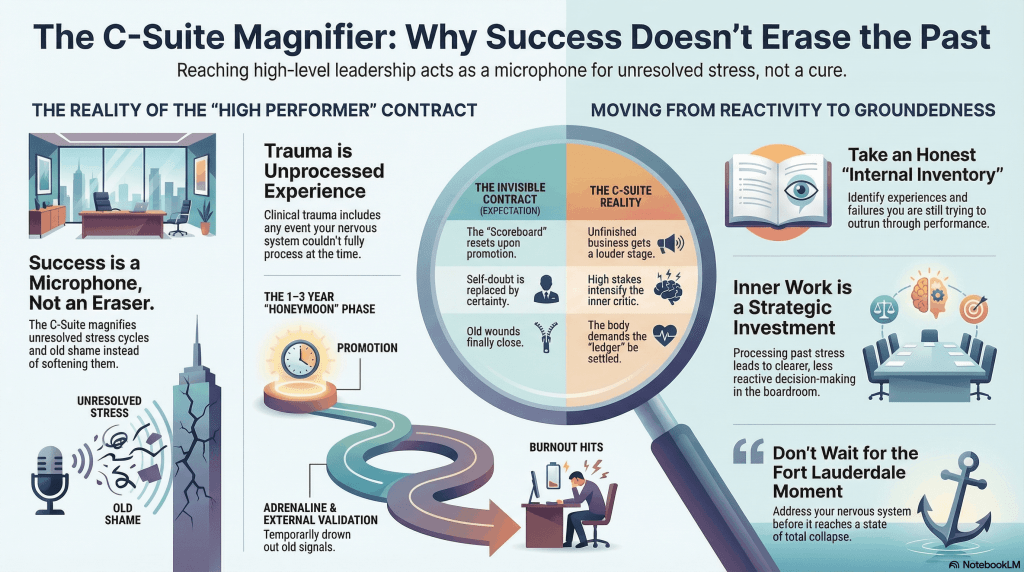
Work hard enough. Climb high enough. Prove yourself enough. And someday, the scoreboard resets.
The missteps get redeemed. The self-doubt gets replaced by certainty. The old wounds close. You finally feel like you’ve arrived, not just at a title, but at a version of yourself that is finished with all the struggle.
Here’s the thing. That contract was never going to be honored. Not because you didn’t work hard enough. But because that’s not how the human nervous system works.
Success doesn’t rewrite history. It just gives your unfinished business a louder microphone.
What Executive Burnout Often Looks Like From the Inside
When I talk to executives who are burning out, most of them describe the same disorienting experience. They say something like: “I’ve achieved everything I set out to achieve. I should feel good. So why do I feel worse?”
That question is not a sign of ingratitude. It’s a sign that the false belief has finally met reality.
The C-Suite magnifies what’s already inside you. If you walked into it carrying unresolved stress cycles, old shame that never got processed, or a relentless inner critic you’ve been outrunning for years, those things don’t soften with success. They intensify. The higher the stakes, the louder the noise.
This is one of the reasons the timeline to burnout surprises so many leaders. The honeymoon phase after a major promotion can last a year. Sometimes two or three. The adrenaline of the new role, the novelty, the external validation, it temporarily drowns out the old signals.
But the signals are still there. And they don’t wait forever.
The Body Keeps the Score, Even When You Don't
Here’s a concept worth sitting with for a moment.
Trauma doesn’t require a dramatic event. Most people think it does. We associate trauma with headlines, with catastrophic losses, with things that show up in movies.
But trauma, in the clinical sense, is anything your nervous system couldn’t fully process at the time it happened. The public failure where you kept your face neutral but died inside. The restructuring you led that cost people their jobs while you held the company line. The criticism from a board member that landed harder than anyone knew. The marriage that frayed under pressure while you kept showing up to work like nothing was wrong.
Executives are among the most skilled avoiders in the world. We learned early that powering through discomfort got rewarded. So we kept doing it. Decades of shoving experiences aside because there was always another deal to close, another quarter to defend, another fire to put out.
Your body tracked every one of them. It is keeping a ledger you haven’t looked at.
And the C-Suite, with all its visibility and pressure and relentlessness, tends to demand that ledger get settled. Usually at the worst possible time.
What I Learned the Hard Way
There was a period in my career when I genuinely believed I was building toward something that would make the hard parts worth it. The roll-up strategy. The five acquisitions. The revenue growth. The title.
What I was actually building was a pressure system with no release valve.
The unprocessed stress didn’t soften as my career accelerated. It compounded. By the time I broke down in Fort Lauderdale Airport, sobbing in a way I hadn’t since childhood, I wasn’t just exhausted from that week. I was carrying years of stress cycles that had never completed. My body finally forced the accounting.
I’m not unique in this. Far from it. The pattern shows up in nearly every executive I coach. The presentation changed. The title changed. The pressure changed. But the unfinished inner work was still there, waiting.
The C-Suite didn’t create my wounds. But it absolutely accelerated the reckoning.
So What Do You Do With This?
First, take inventory with honesty. Not of your achievements. Of your unfinished business.
What experiences from your career, or before it, do you still carry forward? What are you still defending against? What parts of your history are you still trying to outrun through performance?
Second, understand that processing this is not weakness. It is the single most strategic investment you can make as a leader. The executives who do this work don’t become softer. They become clearer. They make better decisions. They stop leading from reactivity and start leading from groundedness.
Third, recognize that the window matters. You don’t want to wait until the Fort Lauderdale moment to start looking inward. The work is far harder when your nervous system is already in collapse.
Start now, not because you’re broken, but because you’re smart enough to see what’s coming.
The C-Suite cannot erase your past. But you can complete it.
That’s the work. And it’s the most important work you’ll ever do.
Ready to take a closer look at what you might be carrying into the boardroom?