
What Is an Executive Coach and Why Would You Need One?
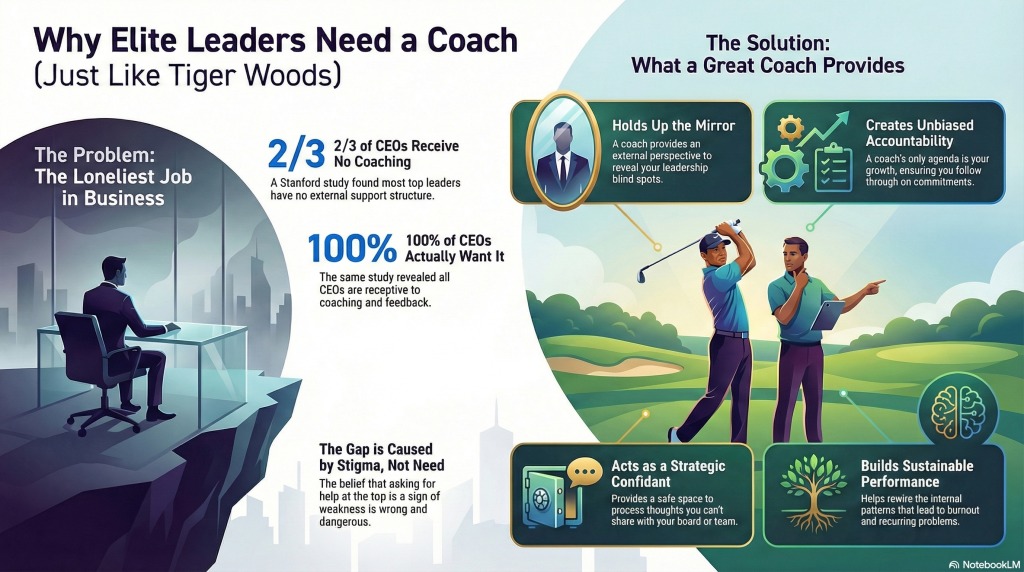
Tiger Woods won eight major championships with Butch Harmon as his swing coach. Eight. During what many consider the most dominant stretch in golf history, the greatest player on the planet had someone watching his every move, analyzing his mechanics, and holding up a mirror he couldn’t hold himself.
He didn’t need a coach because he was struggling. He needed a coach because he was elite.
Here’s the thing: we accept this logic completely in sports. No one questions why LeBron James has a shooting coach. No one wonders if Serena Williams is “weak” because she works with a performance team. We understand that at the highest levels of competition, external perspective isn’t a crutch—it’s a weapon.
So why do executives think they should go it alone?
The Loneliest Job in Business
A Stanford study found that nearly two-thirds of CEOs do not receive any external coaching or leadership advice. Two-thirds. The people running the most complex organizations, making the highest-stakes decisions, navigating the most pressure—most of them have no formal support structure at all.
And yet, here’s what the same study revealed: 100% of CEOs surveyed said they enjoy receiving coaching and are receptive to making changes based on feedback.
Read that again. They all want it. Most don’t get it.
This gap isn’t about need. It’s about stigma. Somewhere along the way, we decided that asking for help at the top meant you weren’t ready to be there. That’s not just wrong—it’s dangerous. Because when leaders stop receiving honest feedback, blind spots multiply. Patterns calcify. And the crash, when it comes, catches everyone off guard.
What an Executive Coach Actually Does
An executive coach is a trained professional who works one-on-one with leaders to improve performance, build self-awareness, and develop sustainable leadership habits. But let me be more specific, because “coaching” has become one of those words that means everything and nothing.
A good executive coach does four things exceptionally well:
They hold up the mirror. You can’t see your own blind spots. That’s what makes them blind spots. A coach brings an external perspective that reveals patterns you’ve normalized, habits you’ve stopped questioning, and behaviors that might be undermining your effectiveness without your awareness. When I was leading a PE-backed platform company through five acquisitions, I couldn’t see how my “drive” had become something more destructive. I needed someone outside the fog to name what I couldn’t see myself.
They hold you accountable. Not in a punitive way—in a supportive way. Executives are often surrounded by people who are incentivized to tell them what they want to hear. A coach has no agenda other than your growth. They remember what you committed to last month. They notice when you’re rationalizing. They ask the uncomfortable questions your direct reports won’t.
They become your confidant. There are thoughts you can’t share with your board. Fears you can’t voice to your leadership team. Doubts that would erode confidence if spoken in the wrong room. A coach creates a safe space where you can process the full weight of leadership without strategic consequences. That confidentiality isn’t a luxury—it’s essential for mental clarity.
They help you build sustainable performance. This is the piece most people miss. Coaching isn’t about fixing a single problem. It’s about rewiring the internal patterns that created the problem in the first place—and all the future problems waiting in line behind it. A coach doesn’t just help you survive the current crisis. They help you become the leader who handles the next one differently.
You Can’t Be Too Good to Need a Coach
This is the myth that keeps too many leaders isolated. The belief that needing support is a sign of weakness. That asking for help means you’re not ready for the role.
Think about it this way: Tiger Woods won his first major at 21 with Butch Harmon in his corner. He was already the best. He still needed a coach. In fact, because he was the best, he needed a coach—someone who could see the micro-adjustments invisible to his own eye, someone who could keep a swing that was already world-class from drifting into dysfunction.
Leadership works the same way. The higher you climb, the fewer honest voices you hear. The more success you accumulate, the easier it is to believe your instincts are infallible. And that’s precisely when the drift begins—slow, imperceptible, and eventually devastating.
The executives who last, who sustain both performance and presence, are the ones who build external support into their operating system. Not as remediation. As infrastructure.
Different Types of Coaching for Different Needs
Not all coaching is created equal. Understanding the landscape helps you find the right fit:
Executive Coaching focuses specifically on C-suite and senior leaders navigating high-stakes organizational challenges. This is deep work on leadership presence, strategic thinking, emotional regulation, and the internal patterns that shape how you show up under pressure.
Leadership Coaching is broader and can apply to emerging leaders, managers stepping into new roles, or high-potential talent being developed for future positions. The focus is often on skill-building: communication, delegation, conflict resolution, team development.
Performance Coaching targets specific outcomes: hitting targets, improving productivity, overcoming a particular bottleneck. Think of this as more tactical—addressing the “what” more than the “who.”
Transition Coaching supports leaders moving into new roles, organizations, or life stages. The first 100 days of a CEO tenure, for example, or an executive navigating a career pivot. The focus is on accelerating adaptation and avoiding early missteps.
Mental Fitness Coaching (which is the foundation of my own work) goes deeper still. This isn’t about strategy or skills alone—it’s about rewiring the cognitive patterns that drive reactive leadership, emotional volatility, and the internal narratives that lead to burnout. It’s mindset as infrastructure, not add-on.
The ROI of Executive Coaching Isn’t Abstract
Research consistently shows that executive coaching delivers measurable returns. A Metrix Global study found an ROI of 788% based on productivity and retention gains. Another study reported that 70% of executives who worked with coaches experienced improved performance and leadership effectiveness.
But here’s what the numbers don’t capture: the crisis that didn’t happen. The relationship that didn’t fracture. The decision that didn’t get made in a reactive fog. The burnout that was intercepted before it became a breakdown.
When I crashed in 2023—standing in Fort Lauderdale Airport unable to function—the cost wasn’t just personal. It was organizational. It was strategic. It was felt by everyone who depended on my leadership. What would it have been worth to catch that spiral six months earlier? A year earlier? Before the patterns hardened into a path I couldn’t exit?
That’s the ROI no spreadsheet will ever fully calculate.
The Invitation
If you’ve made it this far, something in these words landed. Maybe you’re already sensing the patterns I describe. Maybe you’ve been carrying more than you should, longer than you should, without the external support you deserve.
I crashed. But you don’t have to.
The work I do now is built on everything I learned the hard way, the ten blind spots that lead to burnout, the false beliefs that keep leaders trapped, and the mental fitness practices that create sustainable performance. If you’re curious about what working with a coach could look like, I’d welcome the conversation.
Because here’s the final truth Tiger Woods understood: having a coach doesn’t mean you’re not good enough. It means you’re serious about being your best.
And that’s not weakness. That’s wisdom.
Ready to explore what coaching could mean for your leadership? Book a discovery call to discuss the ten blind spots and whether this work might be right for you. And if you haven’t already, subscribe to Project CRASH for weekly insights on building sustainable leadership.