
Why Every Burned-Out Executive Thinks They're the Only One Struggling
Picture this: You’re at a leadership dinner in a nice restaurant. Eight executives around a table. Expensive wine. Nice steaks. Everyone’s sharing wins. Revenue up. Teams performing. Big deals closing.
And You’re nodding along. Smiling. Playing the part.
But maybe things were not going so hot for you. Maybe you hadn’t slept more than four hours in weeks. Maybe you were popping antacids like candy. Maybe your marriage was fraying. Overall maybe you were genuinely terrified that you were losing your grip on everything.
You didn’t speak of those things because you imagined you were the only one hurting.
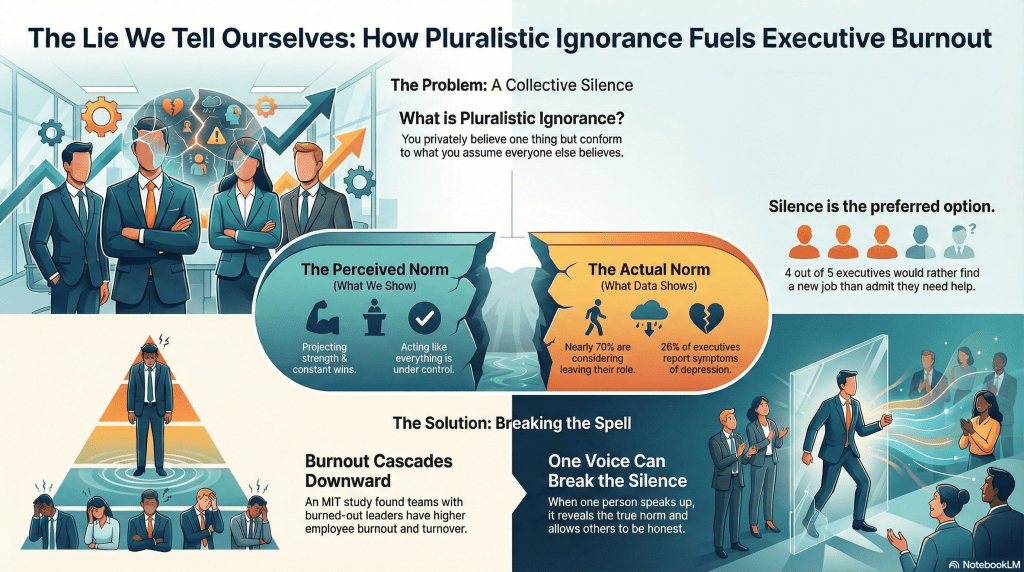
But here’s the thing I learned the hard way: Given what we now know about executive burnout—that nearly 70% of C-suite leaders surveyed by Deloitte were seriously considering leaving for a role that better supports their well-being —at least a few of the executives at that table were likely fighting the same silent battle. But nobody said a word.
The Name for the Lie We Tell Each Other
There’s a psychological phenomenon called “pluralistic ignorance.” Here’s what it means in plain English: You privately believe one thing, but you assume everyone else believes the opposite—so you go along with what you think the group thinks. Meanwhile, most people in the group are doing the exact same thing. Everyone conforms to a norm that almost nobody actually holds.
In the context of executive burnout, it plays out like this: You’re struggling, but everyone else looks fine. So you perform “fine” too. And the person next to you? Same calculation. Everyone’s hiding the same secret from each other.
A Deloitte survey found that nearly 80% of C-suite executives said they’d rather find a new job than talk to someone internally about their mental health struggles.
Let me repeat that: four out of five executives would rather leave their company than admit they’re not okay.
That’s not individual weakness. That’s collective silence protecting a destructive norm.
The Burnout Everyone's Hiding
Research from McLean Hospital shows that 26% of executives report symptoms consistent with clinical depression—compared to 18% in the general workforce. Fortune reported that more C-suite executives struggle with depression than their employees do.
And yet we keep performing. We keep nodding at dinners. We keep posting LinkedIn wins.
Why? Because pluralistic ignorance creates a self-reinforcing loop.
You see everyone else appearing strong. You assume the expectation is to be strong. So you project strength. The person watching you sees your projection and assumes the same thing. And around it goes.
Nobody wants to be the first one to break the silence and say, “Actually, I’m drowning here.”
Because—and this is the painful part—we assume we’ll be judged. We’ll be seen as incapable. We’ll be replaced.
So we pretend. We show up, smile, and perform. Even when we’re running on fumes.
The Meeting Nobody Leaves
Remember those meetings that drag on forever? Research by psychologist Solomon Asch and later by John Darley showed something remarkable: people will sit in a room filling with smoke and not say anything, as long as everyone else stays quiet.
That’s pluralistic ignorance in action. And it’s happening in boardrooms everywhere—except instead of smoke, it’s burnout.
Nobody wants to be the first to admit they’re struggling because they assume everyone else is handling it just fine. So the meeting continues. The late nights continue. The crushing expectations continue.
And everyone silently assumes they’re the only one who can’t keep up.
What I Learned the Hard Way About Breaking the Cycle
When I finally crashed—really crashed—one of the most startling discoveries was this: my story wasn’t unique. Not even close.
The moment I started talking openly about my burnout, other executives started pulling me aside. “That happened to me too.” “I went through something similar.” “I thought I was the only one.”
Turns out the perceived norm—the invincible, always-on, crushing-it executive—was a collective fiction. The actual norm? Most people were barely hanging on, just like me. They were just too afraid to say it out loud.
This is what researchers call the gap between the “perceived norm” and the “actual norm.” When that gap is significant, pluralistic ignorance is at work.
And in executive leadership, that gap is a canyon.
The Cost of Collective Silence
Here’s what makes this dangerous: burnout cascades.
When leaders model “always-on” behavior, teams interpret it as the expectation. An MIT study found that teams with burned-out executives show significantly higher rates of employee burnout, disengagement, and turnover.
Why? Because employees hide their struggles to match what they perceive as their leader’s “toughness.” They avoid vacations. They skip breaks. They mask stress.
The organization becomes a pressure cooker. And it all started because everyone assumed they were the only one struggling.
Breaking the Spell
Pluralistic ignorance is broken the moment one person speaks up.
That’s both the challenge and the opportunity. Once someone names what everyone is privately feeling, the spell dissolves. Others feel permission to be honest. The actual norm becomes visible.
This is why I tell my story now. Not because I have it all figured out—I don’t. But because someone has to be willing to say it first: “I wasn’t okay. I crashed. And I bet some of you are closer to that edge than you’re admitting.”
The research backs this up. Studies show that when one person breaks the silence, it creates space for collective honesty. The perceived norm collapses, and people discover they’re not alone.
The Question I Want to Leave You With
Here’s what I’d ask you to consider: What if you’re not the exception? What if the image of strength you’re projecting—and that you see others projecting—is just pluralistic ignorance in action?
What if everyone at your table is struggling too, and nobody wants to be the first to say it?
You don’t have to crash to learn this lesson. I did, but you don’t have to.
Maybe start by naming what’s true for yourself. Find one trusted person and tell them how you’re actually doing. Not the LinkedIn version. The real version.
Because the collective lie only survives as long as everyone agrees to keep telling it.
And you don’t have to be the one who keeps it alive.
I crashed, but you don’t have to. If any of this resonates, I’d love to hear from you. And if you want more conversations like this—the real ones, not the performance—subscribe to the Project Crash newsletter below.
Subscribe to the Project Crash newsletter: https://www.linkedin.com/newsletters/project-crash-7395172366567514112