
Why Stuck Is Worse Than Busy: What CEOs Need to Know About Burnout in 2025
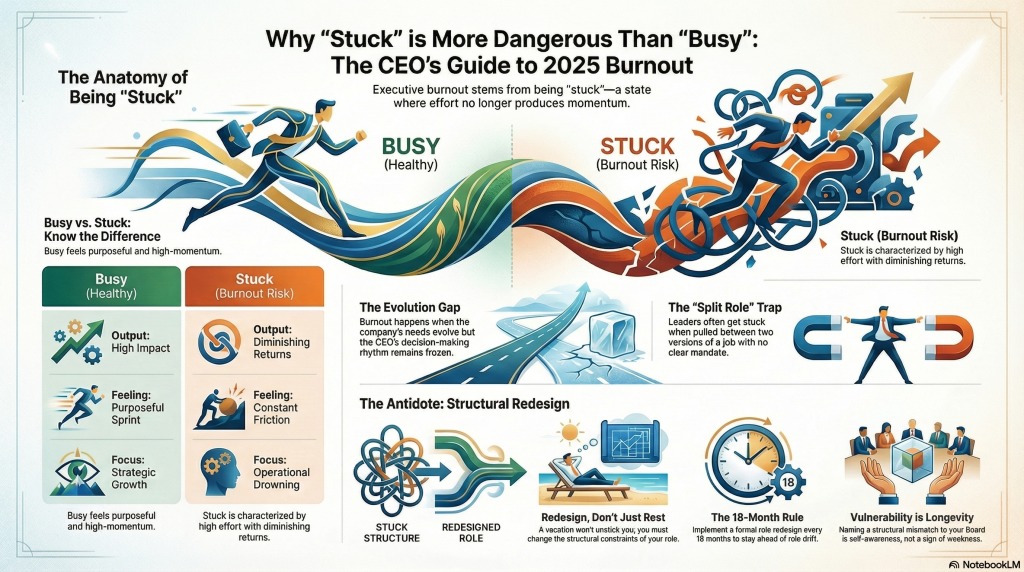
Most people think burnout hits when the workload becomes unbearable. Too many meetings. Too many decisions. Too many fires.
But here’s the thing — that’s not usually what breaks a CEO.
What breaks them is doing the same things harder and going nowhere.
Stuck. Not overwhelmed. Stuck.
That distinction cost me more than I care to admit. And once I understood it, everything about how I thought about burnout changed.
The Burnout Myth Most Executives Believe
There’s a widely held assumption that executive burnout is a workload problem. Work less, rest more, take a vacation. Problem solved.
Real talk: that’s not it.
When I was running a PE-backed platform company through a roll-up — five acquisitions, rapid revenue growth, constant board pressure — I wasn’t burning out because I was too busy. Busy felt fine. Busy felt purposeful.
The breakdown came later. When the pace stayed the same but the progress stopped feeling real. When I was pouring everything in and getting diminishing returns. When the job I had signed up for had quietly morphed into something I didn’t recognize, and nobody had told me.
That’s the stuck feeling. And it hits harder than any sprint ever could.
What 'Stuck' Actually Looks Like for a CEO
It doesn’t announce itself. It creeps in.
You’re still putting in the hours. You’re still showing up to every meeting, answering every message, solving every problem. But somewhere along the way, the work stopped producing the kind of results — or the kind of energy — that used to come with it.
Maybe your role has expanded to the point where you’re drowning in operational details you weren’t hired to manage. Maybe you’ve been so focused on building the machine that you forgot to keep evolving the driver. Maybe the company has grown beyond the version of leadership it started with, and nobody has had the honest conversation about what that means.
Here’s what stuck looks like in practice: more effort, less momentum. More activity, less impact. More performance, less meaning.
Sound familiar?
The Fix Isn't Rest — It's Structural Change
I want to be careful here, because rest matters. Recovery matters. Sustainable pace matters. But if you’re stuck, a vacation won’t unstick you. You’ll come back refreshed and immediately land in the same set of constraints.
The antidote to stuck isn’t rest. It’s redesign.
One CEO I learned about had built something genuinely remarkable with her board — a formal role redesign every 18 months. Not a performance review. Not a check-in. A structural conversation about whether her role was still the right shape for where the company was heading, and whether it was still the right fit for where she was in her own growth.
Eighteen months. Regular enough to stay ahead of the drift. Structured enough to make real change possible.
That kind of intentionality is rare. But it’s what leadership longevity actually looks like.
When the Role Outgrows the Leader — or the Leader Outgrows the Role
There are two ways stuck shows up at the top, and they’re worth understanding separately.
The first is when the company’s needs have evolved and the CEO’s role hasn’t kept pace. What worked in year one of a growth phase looks nothing like what’s needed in year four. The skills, the structure, the decision-making rhythm — all of it needs to evolve. When it doesn’t, the leader ends up fighting the same battles with the same tools and wondering why nothing’s moving.
The second is more personal. The leader grows — develops new strengths, new interests, new capabilities — but the role stays frozen. I’ve seen this in consulting too. You build a practice that mixes hands-on client work with advising and coaching, and somewhere in there, the doing and the coaching start pulling against each other. You’re not bad at either. You’re just split between two versions of the job with no clear mandate for either.
That split is a textbook stuck scenario. And the fix isn’t working harder at both. It’s renegotiating scope.
The Conversation Most CEOs Never Have
Here’s what I’ve seen over and over: executives who are stuck don’t talk about it. Not to their boards. Not to their teams. Not to their peers.
Partly it’s pride. Partly it’s the belief that admitting stuck is admitting failure. Partly it’s that they’re too deep in the day-to-day to step back and name what’s happening.
But the cost of that silence compounds. The longer stuck goes unnamed, the more it festers. What starts as restlessness becomes resentment. What starts as low energy becomes a full system shutdown.
I know. I’ve been there. Fort Lauderdale Airport, after my son’s graduation, unable to hold it together. That wasn’t a single bad day. That was years of stuck finally surfacing.
The conversation most CEOs never have is the one where they say, out loud, to someone who can actually do something about it: “The way my role is structured right now isn’t working anymore. Something needs to change.”
That conversation is not weakness. That conversation is exactly the kind of self-awareness that separates leaders who last from leaders who crash.
How to Renegotiate Before You Break
You don’t have to wait for a crisis to have the structural conversation. In fact, the whole point is to have it before the crisis arrives.
Start by asking yourself some honest questions. Has your role evolved with the company, or are you still doing the job you were hired for three years ago? Are there parts of your role that energize you and parts that consistently drain you — and have you ever named that distinction out loud? When did you last have a real conversation with your board, your coach, or your business partner about whether your scope still makes sense?
If the answers make you uncomfortable, that’s information. That discomfort is the early warning system doing its job.
In my book, Crash and [Burn] LEARN, I write about the ten blind spots that lead to burnout. Several of them show up directly in the stuck pattern — the belief that pushing harder will eventually work, the isolation that keeps you from asking for help, the identity tied so tightly to the role that changing the role feels like losing yourself.
None of that has to be your story.
Because I crashed, but you don’t have to.
If any of this is hitting close to home, let’s talk. I offer a complimentary discovery call for executives who want to understand where they are in the burnout cycle and what their options look like. You can book with me directly!