
Why the C-Suite Can’t Silence Your Inner Critic
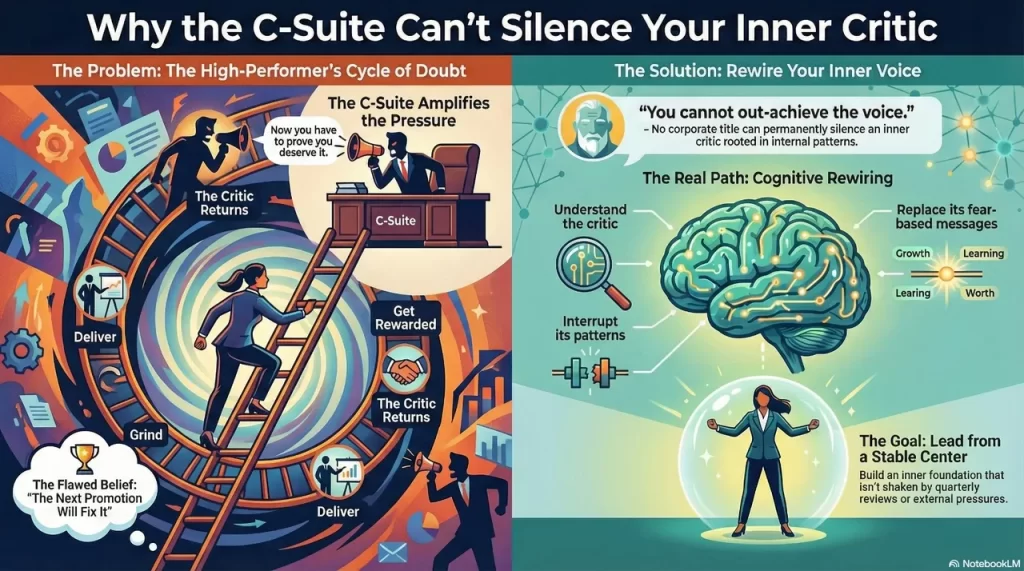
I used to think the C-Suite would finally shut that voice up.
You know the one. The quiet whisper that shows up right after a big win and tells you it wasn’t enough. Or that you only succeeded because the timing was lucky. Or that someone smarter would have done it better.
Most executives carry that voice around like a second spine. We get so used to it that we mistake it for motivation. We let it push us. Prod us. Shame us into going harder. And we convince ourselves that once we get high enough in our career, the voice will fade.
It won’t.
If anything, it gets louder.
Real Talk About Executive Impostor Syndrome
If you’re human, you’ve had moments where part of you believes you’re one step away from being exposed. It doesn’t matter how much evidence you’ve collected to the contrary. It doesn’t matter how many results you’ve delivered.
That inner critic has one job. Doubt.
You look at your performance. You see the metrics, the outcomes, the promotions. Your rational brain says, “I earned this.”
Then the voice sneaks in.
“Yes, but someone else did it faster.”
“Yes, but your competitor had a disastrous year.”
“Yes, but you’re still not as sharp as the COO who left last quarter.”
That voice is relentless. And it always finds a comparison that tilts the scale against you. If you let it speak unchecked, it will rewrite your entire identity.
The Pattern High Performers Fall Into
Here’s the thing about ambitious people. We tell ourselves the next project will be the one that proves we’re legitimate. The next promotion will be the one that finally makes us feel worthy. The next big initiative will erase every doubt.
So we take the assignment. We grind through it. We deliver. We get praised. We get rewarded. And then what?
The voice returns. Same tone. Same script. Same erosion.
“No, that wasn’t the one. But the next one will be.”
This cycle repeats every three to five years. Which also happens to be the average length of time most leaders stay in a role before the next step up.
By the time we’re in line for the C-Suite, we’ve lived through this loop so many times we’ve internalized a dangerous assumption: “This one will finally shut the critic down once and for all.”
It won’t. Because the critic isn’t tied to the work. It’s tied to the wound that shaped the voice to begin with.
Why the C-Suite Actually Makes It Worse
The voice feels useful. That’s part of the trap.
It keeps us sharp. It keeps us driven. It keeps us hungry.
That’s the mythology. But here’s the truth that executives don’t like admitting: the inner critic doesn’t fuel excellence. It fuels tension.
And that tension becomes structural. It embeds itself in your identity. It becomes the operating system that powers your ambition. You build a tower of success on top of unstable emotional footing, and because the tower keeps rising, you convince yourself the foundation is fine.
Until it isn’t.
When you finally step into the C-Suite, the voice doesn’t congratulate you. It recalibrates.
“You got the title. Now you’d better prove you deserved it.”
“Everyone is watching.”
“One mistake and they’ll know.”
The intensity increases because the stakes increase. That’s why so many executives find themselves burning out not before the C-Suite, but shortly after arriving. The voice has been building pressure for decades. It finally reaches critical mass at the very moment you expected relief.
The irony isn’t lost on me. I lived it.
The Only Way That Voice Ever Gets Quiet
There’s no title in the corporate world that can silence your inner critic. None.
The only thing that works is rewiring the relationship altogether.
That starts by understanding what type of critic you’re dealing with. Then by interrupting the patterns it uses to hijack your thinking. And then by replacing its messages with something grounded in reality rather than fear.
This is not soft psychological theory. It’s cognitive rewiring. When you build new neural pathways, you permanently weaken the old ones.
You cannot out-achieve the voice. You cannot outrun it. You cannot bury it under success.
You have to confront it directly.
Why This Matters Before Your Next Promotion
If you believe the C-Suite will finally validate you, you’re wrong. You’re stepping into the most demanding role of your life with a flawed expectation that will drain you instead of strengthen you.
The C-Suite magnifies what’s already inside you.
If your inner critic is running the show today, it will run the boardroom tomorrow.
You deserve better than that. And the people you lead deserve a version of you who isn’t battling invisible sabotage during every decision.
I’ve watched leaders transform entire careers by rewiring this single pattern. The work isn’t about becoming less ambitious or lowering your standards. It’s about building a stable center that doesn’t swing between “I’m the best” and “I’m a fraud” based on your last quarterly review.
You don’t need a different title.
You need a different inner voice.
—
This is False Belief #2 from my new book, Crash and [Burn] LEARN: A Business Fable About the High Cost of Burnout, Blind Spots, and the Hope of Recovery. If this resonates, subscribe to my newsletter Project Crash for more insights on leading without losing yourself.
Subscribe here: https://www.linkedin.com/newsletters/project-crash-7395172366567514112