
Work and Life Must Coexist: Call It Balance, Call It Integration, Call It Whatever You Want
You’ve probably seen the headlines. Nvidia’s Jensen Huang works seven days a week and can’t sit through a movie without thinking about work. Zoom’s CEO declares that “work is life.” Billionaire founders brag about sleeping at the office like it’s a badge of honor.
The message is clear: work-life balance is for people who lack ambition. Real leaders grind. Real success requires sacrifice. If you want extraordinary results, forget about balance.
I have never believed that.
Maybe it’s my upbringing in Europe, where people have significantly more PTO and the cultural expectation is that life happens outside the office too. Or maybe I’m just wired that way. But I’ve always believed that a successful, happy life means success at work AND in personal relationships, family, friends, and involvement in community. It’s why I currently serve as Township Supervisor in Upper Macungie, Pennsylvania, even while running a consulting practice. For me, these aren’t competing priorities. They’re all part of the same life.
Why the Anti-Balance Rhetoric Is Dangerous
When a CEO worth billions tells you that work-life balance doesn’t matter, it’s easy to feel like maybe you’re the problem. Maybe you’re not committed enough. Maybe your reluctance to answer emails at midnight is why you haven’t reached their level of success.
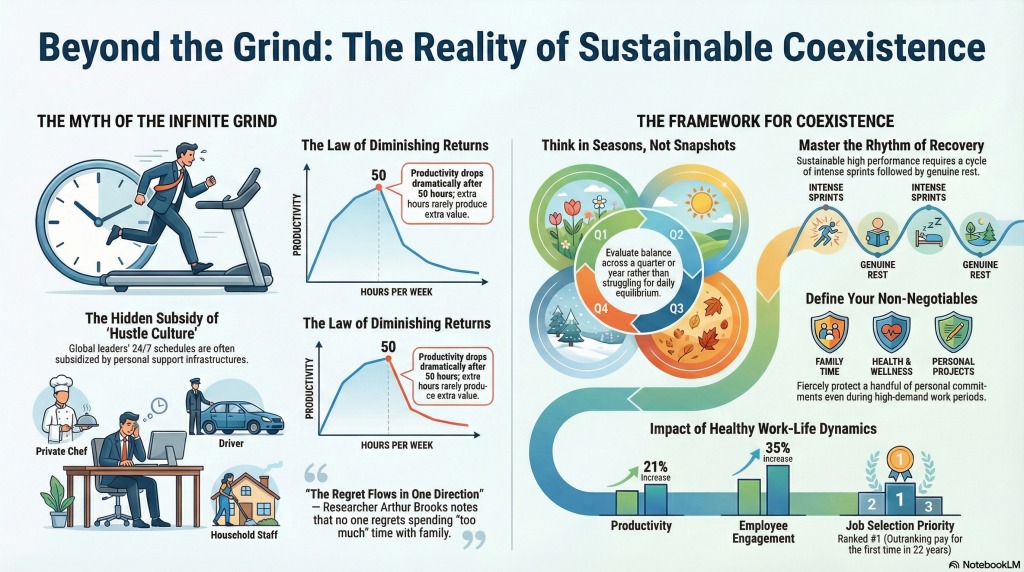
But let’s be honest about what’s actually happening here. These leaders have resources most of us don’t: private chefs, personal trainers, household staff, drivers, and medical teams on call. When Jensen Huang works seven days a week, he’s not also doing his own laundry, making his kids’ lunches, or sitting in traffic. The infrastructure of his life is handled. His “work is everything” lifestyle is subsidized by an army of people managing everything else.
For the rest of us, adopting that mindset without that infrastructure is dangerous. Yes, it increases the risk of burnout. But here’s what might be even worse: you might NOT burn out. You might sustain that pace for decades, only to arrive at retirement and realize you missed the parts of life that actually mattered.
Arthur Brooks, the Harvard professor and happiness researcher, puts it perfectly: “No one sighs regretfully on his deathbed and says, ‘I can’t believe I wasted all that time with my wife and kids,’ ‘volunteering at the soup kitchen,’ or ‘growing in my spirituality.'” The regret flows the other direction. Always.
Forget the Label, Focus on the Practice
Here’s where I part ways with the endless debate about terminology. Work-life balance. Work-life integration. Work-life harmony. Work-life coexistence. Pick whichever phrase resonates with you. The label doesn’t matter. What matters is the underlying truth: work and life must coexist for us to have fulfilling lives.
The phrase “work-life balance” has become almost meaningless, conjuring images of perfectly equal time spent in separate boxes: 50% work, 50% life, neatly divided. That’s not how leadership works. There are seasons when work demands more. Product launches, acquisitions, crises. Pretending you can maintain perfect equilibrium through those moments is naive.
But the solution isn’t to abandon the concept entirely. It’s to understand what sustainable coexistence actually looks like in practice.
What Sustainable Coexistence Looks Like
Coexistence acknowledges that work and life aren’t opposing forces fighting for territory. They’re intertwined. They affect each other constantly. The goal isn’t to build walls between them. It’s to ensure they can exist together without one consuming the other entirely.
This means accepting that some weeks will be work-heavy. But it also means building systems that ensure those intense periods are followed by genuine recovery. It means creating non-negotiables, the handful of commitments outside work that you protect fiercely, even when everything feels urgent. It means recognizing that sustainable high performance requires both the accelerator and the brake.
The executives who thrive long-term aren’t the ones who work the most hours. They’re the ones who understand rhythm. Push and recover. Sprint and rest. Engage fully, then disconnect fully.
What the Research Actually Shows
The data couldn’t be clearer. Harvard Business Review found that employees with healthier work-life dynamics are 21% more productive and 35% more engaged. Randstad’s 2025 Workmonitor report shows that work-life balance now outranks pay as the top factor for workers choosing jobs, the first time that’s happened in 22 years of tracking.
Meanwhile, research on long work hours consistently shows diminishing returns. After about 50 hours per week, productivity per hour drops dramatically. Beyond 55 hours, you’re essentially just showing up. The extra time isn’t producing extra value. It’s producing exhaustion, errors, and eventual collapse.
So when billionaire CEOs brag about working every waking hour, remember: they’re describing their personal mythology, not a replicable strategy for success.
The Secret: Choosing the Right Time Horizon
Here’s the key insight that changes everything: sustainable coexistence requires choosing the right time horizon to evaluate it.
Look at a single day or week, and coexistence often feels impossible. Work demands surge, deadlines collide, and something has to give. On a day-to-day basis, one part of life will almost always take priority over another. That’s reality, not failure.
But zoom out to a quarter or a year, and suddenly it becomes much more manageable to make space for ALL that’s important. The intense work sprint in January gets balanced by protected family time in February. The heavy travel month is followed by a month of coaching your kid’s team. The quarterly board prep is offset by the vacation that comes after.
The executives who achieve sustainable coexistence aren’t the ones who perfectly balance every day. They’re the ones who design their quarters and years to include everything that matters. They think in seasons, not snapshots.
The Real Measure of a Fulfilling Life
The CEOs telling you that balance doesn’t matter? Many of them haven’t hit their wall yet. Some never will, thanks to genetic luck or extraordinary support systems. But most executives aren’t that fortunate. Most of us need to design our lives intentionally or watch them unravel.
And even the ones who sustain the grind without burning out may face something worse: arriving at the finish line and realizing they missed the race that actually mattered.
Call it balance. Call it integration. Call it coexistence. Call it whatever you want. The label doesn’t matter. What matters is this: work and life must coexist for us to have fulfilling lives. Your health, your relationships, your community involvement, and your mental clarity are assets worth protecting.
Don’t let anyone convince you otherwise. Especially not someone with a private chef.