
You Don't Have a Time Problem. You Have an Energy Problem.
I used to think I was bad at time management.
I had the calendar. I had the systems. I had the assistant who guarded my schedule like a hawk. And still, I would end most weeks feeling like I had run a marathon in flip-flops. Exhausted, scattered, and oddly behind despite logging 60-plus hours.
Here’s the thing: I wasn’t managing the wrong resource. I was managing it the wrong way. The problem was never my calendar. The problem was my energy.
And I didn’t figure that out until I crashed.
When Managing Time Isn't Enough
Most high-performers I coach come in talking about productivity. They want better systems, smarter delegation, tighter agendas. What they’re describing, though, isn’t a time problem. It’s an energy problem wearing a time problem’s clothes.
You can have all the hours in the world and still show up depleted. You can block your calendar perfectly and still feel like you’re running on fumes by Wednesday.
The calendar can tell you where your hours went. It cannot tell you why you feel empty after spending them.
That distinction cost me years. Maybe it’s costing you right now.
The Weekly Energy Audit: What It Is (and What It Isn't)
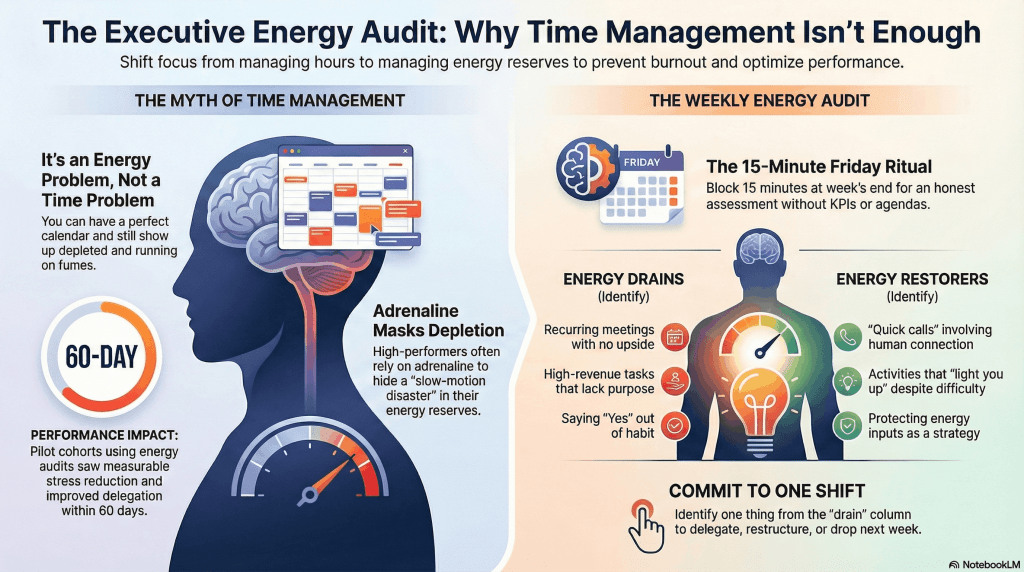
Here’s what I’ve started doing, and what I’ve begun introducing to the executives I work with: a weekly energy audit.
Not a productivity review. Not a KPI check. Not a glorified to-do list retrospective.
An honest assessment of what drained you and what restored you during the week.
That’s it. Two questions. Simple, uncomfortable, and surprisingly powerful.
What drained my focus and sense of purpose this week?
What restored it?
When you start answering those questions with genuine honesty, a pattern emerges. You start seeing that certain meetings leave you wrecked no matter how well they go. That certain kinds of work light you up even when they’re hard. That you’ve been saying yes to a lot of things in column one and almost nothing in column two.
That pattern is data. And data, for most of us in the C-suite, is something we know how to use.
Why This Lands Differently for Senior Leaders
There’s a reason traditional burnout prevention advice doesn’t stick at the executive level. Telling a CEO to “do less” or “slow down” lands about as well as telling them to breathe underwater. The identity, the drive, the sense of mission, it’s all baked in. You can’t just unplug it.
But reframing burnout prevention as protecting your energy inputs? That’s a different conversation.
That’s not weakness. That’s strategy.
The energy audit doesn’t ask you to stop performing. It asks you to perform smarter. To look at what’s fueling the engine and what’s quietly draining it, and to make intentional choices about what gets more of your time and what gets delegated, restructured, or dropped.
In pilot work with executive cohorts, this practice led to measurable reductions in stress levels and notably better delegation behavior within 60 days. Not because the leaders suddenly had more time. Because they started directing what remained of their energy with more intention.
What the Audit Reveals That the Calendar Doesn't
Most executives I work with are shocked by what the audit surfaces in the first few weeks.
They discover that their highest-energy activity isn’t their biggest revenue-generating one. That a recurring meeting they’ve been hosting for two years is a consistent energy drain with little upside. That the “quick calls” they keep taking are actually some of the most restorative parts of their week because they involve real human connection.
They also discover something more uncomfortable: how much they’ve been relying on adrenaline to mask depletion.
I know that one well. I rode adrenaline for years. Took five companies through acquisition, drove a platform through a roll-up strategy, hit revenue numbers I once thought were impossible. And the whole time, my energy audit, had I been doing one, would have looked like a slow-motion disaster. Everything in the drain column. Almost nothing in the restore column.
My crash, standing in Fort Lauderdale Airport after my son’s graduation, sobbing and unable to stop, that wasn’t a surprise. It was the bill coming due.
How to Start: Practical Steps for Busy Leaders
The audit doesn’t need to be elaborate. Here’s a version you can start this Friday:
Block 15 minutes at the end of your week. No agenda, no team, no Slack.
Write down three things that drained your energy this week and three things that restored it. Be specific: a name, a meeting, a type of decision, a moment of connection.
Ask yourself: if next week looked more like the restore column and less like the drain column, what would have to change?
One thing. Start with one thing.
You’re not trying to redesign your life in an afternoon. You’re building a practice of honest self-observation. That’s the foundation everything else gets built on.
This Is What Burnout Prevention Actually Looks Like
Burnout doesn’t arrive like a thunderclap. It inches in, week by week, as your restore column quietly empties and your drain column quietly grows. Most executives don’t notice until the gap is too large to bridge on a long weekend.
The weekly energy audit is one of the most practical tools I’ve found for catching that drift early. Not because it’s magic. Because it forces the kind of honesty that high-performance culture tends to suppress.
You are not a machine. Machines run on time. You run on energy.
Start tracking it.
If you want to dig deeper into the patterns that quietly erode executive performance, my book Crash and [Burn] LEARN explores the ten blind spots that lead to burnout, the ones most leaders don’t see until they’re already in the wreckage.