
You're Not Resting. You're Relocating Your Stress.
Summer is almost here. And for most executives, that means one of two things.
Either they’re genuinely looking forward to stepping away — and quietly terrified they won’t actually be able to.
Or they’re already planning how to “stay productive” while they’re gone.
Both are worth examining. Because the way a leader approaches vacation reveals a lot about where they are on the road to burnout.
Here’s the thing: rest isn’t optional. It’s mechanical. Your nervous system needs it the same way your car needs oil. Skip it long enough and the engine doesn’t just underperform — it seizes.
So before you board your flight this summer, here’s what to avoid — and what to actually do instead.
What to Avoid: The Executive Vacation Traps
Most high performers don’t take bad vacations because they’re lazy or undisciplined. They take bad vacations because they’re applying the same optimization mindset to rest that they apply to everything else. And that’s exactly the problem.
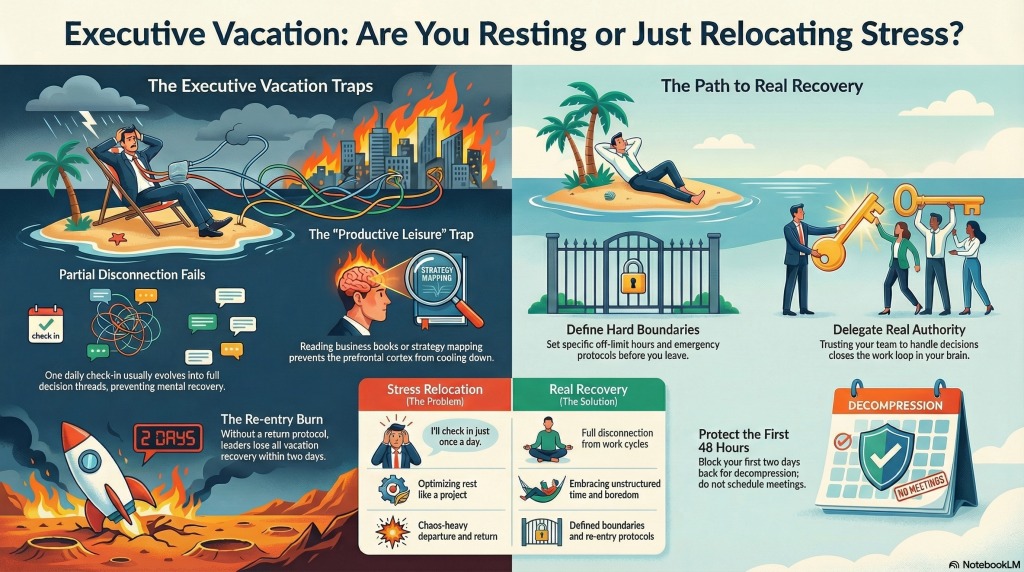
Trap #1: The “I’ll check in just once a day” plan.
It never stays once a day. One check-in becomes two. A quick email turns into a full decision thread. Before long, you’re managing your team from a pool chair and calling it balance. The research is clear: partial disconnection doesn’t deliver meaningful cognitive recovery. Your brain needs a genuine signal that the work cycle is closed — not just paused.
Trap #2: Rebranding work as vacation.
Reading business books on the beach. Listening to strategy podcasts on the hiking trail. Using “quiet time” to map out Q3. Leaders who love their work are especially vulnerable here because it doesn’t feel like working. It feels like thinking. But your prefrontal cortex doesn’t know the difference — and it never gets to cool down.
Trap #3: Optimizing rest like a project.
Rest becomes a tactical recovery period. Exercise becomes a performance enhancer. Family dinners get scheduled for “quality time.” Even leisure becomes transactional. Researchers studying physician burnout found that when people start evaluating personal choices through the lens of professional efficiency, joy becomes something accidental rather than something lived. That’s not recovery. That’s just a different kind of depletion.
Trap #4: Returning without any real boundary structure.
The week before you leave is usually chaos — tying up loose ends, front-loading decisions, doing the work of two weeks in one. Then you’re gone. Then you’re back, and the inbox has six days of backlog waiting. Leaders who don’t plan the re-entry burn through whatever recovery they managed in the first two days back. You need a return protocol as much as you need the vacation itself.
What's Actually Happening in Your Brain When You Don't Rest
Researchers call it cognitive load persistence. Even when you physically leave the office, your brain doesn’t follow. Your prefrontal cortex — the part that handles decisions, planning, and executive function — keeps running in the background. It doesn’t power down because your out-of-office is on.
Think of it like leaving your car engine running in the garage around the clock. Nothing catastrophic happens at first. The wear just accumulates — quietly, relentlessly — until something gives.
Over time, chronic activation changes things. Stress hormones stay elevated. Sleep becomes shallower. Fatigue becomes the baseline. Emotional resilience erodes without warning. And the executives who once seemed unshakeable suddenly can’t figure out why small things are setting them off.
This is why burnout so often feels sudden to the people around you — and inevitable to the person living it. The vacation that didn’t restore you, stacked on top of the one before it, stacked on top of years of “I’ll rest when things slow down” — it all lands at once.
The body, it turns out, keeps a very accurate ledger.
What Real Recovery Actually Looks Like
Real rest isn’t passivity. It’s not lying around doing nothing and calling it recovery. It’s about giving your nervous system genuine closure — which is something most executives have never actually experienced.
The mind works in cycles. Effort needs completion. Challenge needs resolution. When tasks never end — when goals reset the moment you hit them, when you’re always on the edge of the next thing — your brain never gets the signal that the loop is closed. Real vacation closes those loops. That’s the whole point.
Here’s what that looks like in practice:
Define the boundaries before you leave, not after.
Vague intentions don’t hold. “I’ll try to unplug” is not a boundary. Specific ones do: what hours are off-limits, what topics are off the table at dinner, who is the single designated contact for genuine emergencies — and what counts as a genuine emergency. Write it down. Send it to your team before you go.
Give your team real authority while you’re gone.
The leader who can’t step away without everything stalling isn’t leading — they’re bottlenecking. Vacation is one of the best tests of whether you’ve actually built a team or just surrounded yourself with people waiting for your next instruction. Trust them. Let them surprise you.
Protect the first 48 hours back.
Don’t schedule back-to-back meetings for your return day. Block time to decompress the inbox on your own terms. Give yourself a re-entry — not a re-launch. The leaders who burn through their vacation recovery in the first morning back are the ones who needed the vacation most.
Let the boredom happen.
This is the uncomfortable one. Most high performers are terrified of unstructured time. The moment they’re not optimizing something, the anxiety creeps in. That discomfort is information. It’s your nervous system showing you how dependent it’s become on stimulation. Sitting with it — even briefly — is part of the recovery.
The Deeper Question Worth Asking
Here’s what I’ve learned from working with executives who’ve hit the wall: the quality of your rest is a direct reflection of your relationship with your own worth.
Leaders who can genuinely step away have done the internal work of separating their performance from their identity. They know that their value doesn’t go dark when they put the phone down. They’ve built something more durable than their last quarter’s numbers to stand on.
Leaders who can’t step away — who need the constant motion, the inbox, the decisions — are often running from something. And summer has a way of making that unavoidable.
If you find yourself unable to truly disconnect this summer, don’t just white-knuckle through it. Pay attention to what that’s telling you.
Because the executives who last aren’t the ones who never stop.
They’re the ones who learned that stopping is part of the job.
If this hits close to home, the ten blind spots that lead to burnout — including Boundary Collapse — are explored in depth in my book, Crash and [Burn] LEARN. The assessment at TenBlindSpots.com will show you exactly where you’re most at risk before the summer reveals it for you.